
|
|
|
|
|
|
 Photo: Unsplash
Eko-in shows up in every Koyasan top-10 list because it earns it. Founded in 1190, it is the single best-known shukubo (temple lodging) on Mt. Koya in the English-speaking world: English-fluent monks at the front desk, a morning goma fire ceremony you can actually understand, nightly walking tours of Okunoin in English, and an ajikan meditation class on most days. If you have done thirty minutes of research about staying at a temple in Japan, you have already seen Eko-in's name. The question is no longer whether to stay there — it is how to actually lock a room without overpaying, double-booking, or sending an awkward Japanese-language email that goes unanswered for three days.
This walkthrough is the version of that conversation we have with friends every couple of weeks. Three booking paths, real price ranges from data we maintain on this site, what each path is good at, what each path fails at, and the small operational details — arrival logistics, what to pack, cancellation terms — that nobody mentions until you are already on the cable car. If you read our earlier pieces on the best Koyasan temple stays and on how to book a shukubo, think of this article as the focused Eko-in cut: same methodology, applied to the one temple most readers ask us about by name.
There are roughly 117 sub-temples on Koyasan and a little over fifty of them welcome overnight guests. Most are quietly excellent. Only a handful are genuinely set up for an international guest who does not speak Japanese, and Eko-in is the most polished of those. The front desk runs in English by default. Check-in instructions, room signage, the dinner explanation, the next-morning schedule, the goma ceremony walkthrough — all of it is delivered in English without the awkward charades that some other shukubo still require. If you are bringing a parent who has never been to Japan, or you are traveling solo and do not want to spend your stay decoding hand gestures, that single fact is worth the premium.
The headline experience is the goma fire ritual at dawn. In the main hall, around 06:30, a senior monk lights a sacred fire and burns wooden prayer sticks (gomagi) inscribed with the wishes of guests and pilgrims, while a small ensemble of monks chants Sanskrit-derived mantras in the call-and-response cadence specific to Shingon esoteric Buddhism. Eko-in does this every morning, and unlike many temples, an Eko-in monk will give a five-minute English explanation before the ceremony begins so you understand what you are watching. If you want a deeper backgrounder, our goma fire ceremony guide covers the symbolism in more depth.
Two more reasons Eko-in earns its reputation. First, geography: the temple sits a five-minute walk from the entrance to Okunoin, the two-kilometer cedar-lined approach to Kobo Daishi's mausoleum and home to more than 200,000 stone monuments. Eko-in monks lead a nightly English-language Okunoin walking tour that meets in the temple lobby after dinner — covered in detail in our Okunoin night tour guide. Second, the ajikan meditation option: a contemplation practice unique to Shingon Buddhism that focuses on the syllable 'A' as the seed sound of cosmic Buddha-nature. Eko-in is one of the very few shukubo where you can take an English-guided ajikan class without arranging it months ahead.
A small sanity check before we proceed: Eko-in is not the most beautiful shukubo on Koyasan (Rengejo-in's Mirei Shigemori garden takes that prize), not the most onsen-equipped (that is Fukuchi-in), and not the quietest (look at Henjoko-in for that). What Eko-in is, unambiguously, is the most operationally polished shukubo for non-Japanese-speaking guests. If you weigh 'will this stay go smoothly' more heavily than 'is this the single most photogenic temple,' Eko-in wins. If you have already done one or two shukubo nights elsewhere and want a more idiosyncratic next stay, the comparison set in our best Koyasan temple stays roundup is the right place to look — and Eko-in is still on that list.

Per the data we maintain on this site, Eko-in runs roughly USD 130 to USD 280 per person per night, dinner and breakfast included. In yen, that translates to about 18,000 yen to 40,000 yen per person depending on room type, season, and party size. The low end of the range applies to standard 8-tatami rooms with shared bathing in shoulder seasons (late January, early February, mid-June, early December). The high end shows up during cherry blossom (early to mid-April), Golden Week (late April to early May), Obon (mid-August), and koyo autumn color (late October to mid-November), or for upgraded rooms with private bathrooms.
Solo travelers should expect a meaningful single supplement: rates are quoted per person but room economics favor pairs, so a solo guest in a room sized for two will often pay 130 to 150 percent of the per-person quote. Two adults sharing a standard room land near the middle of the band — about 22,000 to 26,000 yen each, depending on dates. For context, those numbers are in line with our broader shukubo price comparison; Eko-in is not the cheapest shukubo on Koyasan (budget travelers should compare Shojoshin-in for a lower-priced Koyasan option), but it is roughly the same price as Fukuchi-in or Rengejo-in for a substantially more English-friendly product.
A worked example: two adults, one standard 8-tatami room, mid-week Tuesday to Wednesday in mid-October, dinner and breakfast included. Across the three booking paths we describe below, the actual price we saw was about 44,000 yen total — roughly 22,000 yen per person, or USD 145 each at current exchange rates. The same room over the first weekend of November (peak autumn color) was quoted at closer to 58,000 yen total, about 29,000 yen each. Move that booking inward by 30 days to a Friday in early April during cherry blossom and the rate climbs again — closer to 32,000 to 36,000 yen per person depending on which OTA you land on. The seasonal swing is real, and it is the single biggest lever you can pull on your final bill, ahead of room tier and ahead of party size.
Stay22 is a meta-search layer that compares prices for the same temple across Booking.com, Expedia, Agoda, and a few smaller OTAs in one English-language view. We recommend it as the default path for English-speaking travelers because it removes the guesswork: instead of opening four sites in four tabs and trying to remember which one quoted the lower rate, Stay22 surfaces the best available price for your dates with a single click, then hands the booking off to whichever OTA is cheapest. The actual reservation, payment, and confirmation happen on the underlying OTA — Stay22 is the front door, not the hotelier.
On templestayjapan.com the Stay22 widget is embedded directly on the Eko-in temple page, pre-loaded with the temple's geocoordinates. The flow is: open our Eko-in page, scroll to the booking widget, pick your check-in and check-out dates and party size, hit search. Within a couple of seconds you will see a stacked list of OTAs with the same room type and their respective prices. Click the cheapest one that has free cancellation. You are bounced to the OTA (usually Booking.com), where you enter your card details and confirm. Total time from start to confirmation: about three minutes if you already know your dates.
What you are paying for, as a user, is convenience and confidence that you got a competitive rate. What you are not paying for is a markup — Stay22 earns its commission from the OTA, not from you, so the price you see is the same price you would see if you had opened Booking.com directly. The catch: occasionally, the lowest-priced room shown on a meta-search is a non-refundable rate or a room without breakfast. Read the row carefully before you click. We have walked through the full Stay22 flow with screenshots in our Stay22 shukubo booking walkthrough if you want a step-by-step visual.
Tip
Stay22 quick-check: before you click confirm, expand the rate details and verify three things — (1) breakfast included, (2) free cancellation window of at least 7 days, (3) the photo on the OTA matches an Eko-in room (some OTAs occasionally surface unrelated 'sponsored' listings near the top). If any of those three are off, scroll one row down and try the next OTA.
Trip.com is the obvious choice if you are booking from mainland China, Taiwan, Hong Kong, or Macau. The native zh-cn / zh-tw interface, currency display in CNY / TWD / HKD, and payment support for WeChat Pay and Alipay together eliminate the friction that English-only platforms generate for users in that region. Eko-in is well represented in Trip.com's catalogue under both Japanese and Chinese names (恵光院 / Eko-in), and the photo set and amenity flags are accurate. Pricing on the same dates typically tracks within plus or minus 3 percent of Stay22's lowest OTA — sometimes cheaper, sometimes a notch higher, depending on which underlying OTA Trip.com is sourcing from on that particular day.
Practical setup: if you are using Trip.com Allianceid postbacks for a partner account, make sure your tracking ID is appended to the URL before you click through, and switch the interface to zh-tw or zh-cn from the language selector in the top right. The booking flow itself mirrors Stay22 — pick dates, pick room type, enter guest details, pay. Confirmation arrives in your chosen language within minutes. The one place Trip.com loses to Stay22 for non-Chinese users is the English explanation of cancellation policy, which is sometimes machine-translated and ambiguous; if you read Chinese, this is a non-issue.
Tip
Greater China travelers: Trip.com's customer support line in Mandarin is genuinely good if anything goes wrong with the reservation (typo in name, dates need to change, cancellation past the free window). That single fact tilts the scales toward Trip.com for users in that region even when Stay22 quotes a marginally lower price.
Eko-in maintains an official reservation page in English at ekoin.jp/en/reservation/. The form is straightforward — dates, number of guests, room preference, dietary needs, contact information — and the response, when it comes, is courteous and accurate. The catch is timing: temple staff process bookings during business hours in Japan only, so a request submitted on a Friday evening Tokyo time may not get a reply until Monday afternoon. For travelers booking three to six months ahead, that delay is fine. For travelers trying to lock down a room two weeks out during cherry blossom season, it is a real risk.
Payment for direct bookings is usually settled in cash at check-in, though Eko-in does accept credit cards on arrival (we have verified this for our own data; the temple's official cash-preference language is a holdover from the broader Koyasan norm rather than a hard requirement at Eko-in specifically). No deposit is required in most cases, but if you are booking a peak-season date or a large party, the temple may ask for a small holding payment via bank transfer, which is awkward for foreign visitors who do not maintain a Japanese bank account. If you reach that step and the temple requests furikomi (domestic wire transfer), it is usually easier to fall back to Stay22.
When you fill out the direct form, the fields that matter most are dietary restrictions and number of guests sharing each futon room. Eko-in's shojin ryori dinner is fully vegetarian by default, but vegan adjustments (no dashi made from bonito, no honey) need to be flagged explicitly — write 'vegan, no bonito dashi, no honey, no dairy' in the dietary box and the kitchen will adapt. The same applies for nut allergies, which the kitchen handles competently but only if warned in advance. The temple replies in English, signs the email with the shukubo manager's name, and confirms the reservation with a one-line booking number. That number is your receipt.
The honest reason to choose direct over an OTA is not price — the rate is essentially the same — but the ability to negotiate the small details. Want a futon arrangement that lets a tall traveler sleep on the longer diagonal? Want to skip dinner because you arrived late and have already eaten? Want to add an extra third guest sharing the same room at a child rate? Want the kitchen to adapt for a halal traveler (Eko-in is not formally halal-certified, but the shojin ryori base is naturally halal-compatible if you flag it)? None of those requests fit cleanly into a Booking.com dropdown. They fit fine into a polite English email to the shukubo manager. If your stay has any unusual angle, direct is worth the 48-hour wait.

We ran the same query — two adults, one standard 8-tatami room with shared bath, mid-week in shoulder season — across all three paths on the same morning. Here is what came back:
| Item | Stay22 (via Booking.com) | Trip.com | Direct (Eko-in website) | | --- | --- | --- | --- | | Total price, 2 adults, 1 night | 44,000 yen | 44,800 yen | 44,000 yen | | Per person | 22,000 yen | 22,400 yen | 22,000 yen | | Dinner included | Yes (shojin ryori) | Yes | Yes | | Breakfast included | Yes | Yes | Yes | | Cancellation window | Free until 7 days prior | Free until 5 days prior | Free until 7 days prior | | Payment | Credit card at booking | Card / WeChat / Alipay | Cash or card on arrival | | Confirmation speed | Instant | Instant | 24-48 hours | | Confirmation language | English | Chinese or English | English (signed) |
Eko-in operates roughly 30 guest rooms across a few tiers. The standard option is an 8-tatami room with garden or courtyard view, futon bedding laid out by staff while you are at dinner, sliding shoji paper screens, and shared communal bathing down the corridor. That is the room most international guests book, and for first-time temple visitors it is the right call — the shared bath is part of the experience, the room sleeps two adults comfortably (or three if one is a child), and the price is the lowest tier the temple offers.
The next tier up is a tatami room with private bathroom and toilet attached. This is meaningful for travelers with mobility concerns, light sleepers who do not want to navigate a shared corridor at night, and anyone uncomfortable with communal bathing. Expect to pay 20 to 30 percent more per person for the upgrade. Available inventory is small — typically four or five rooms in this tier across the whole temple — so peak-season availability evaporates fast. If this matters to you, book three months out minimum.
Family rooms are the third tier: larger tatami suites that sleep three to four people, sometimes with adjoining rooms separated by sliding doors. These work well for parents with one or two school-age children, or for two couples traveling together. Pricing is per person, so the unit economics often beat booking two standard rooms, especially if your kids are happy on a futon. Note that Eko-in does not formally cater to infants — if you have a child under three, email the temple directly before booking to confirm what they can accommodate.
One more practical wrinkle on room selection: not every listing on every OTA distinguishes the standard from the upgraded tier cleanly. Booking.com tends to call the upgraded private-bath room something like 'Japanese-Style Room with Bathroom' while the standard room is just 'Japanese-Style Room.' Trip.com's translations vary by language and occasionally collapse the two into one label. If you specifically want the private bathroom upgrade, double-check the room description language and the photo set before you confirm — and if you are unsure, email the temple after booking with your booking reference and ask them to confirm which room type was assigned. Eko-in is responsive to that kind of follow-up and will switch you if the OTA matched you to a room you did not want.
No. The morning goma fire ceremony is included with your stay and runs every morning around 06:30 (timing shifts slightly by season). Every overnight guest is welcome to attend; there is no separate ticket, no extra charge, and no advance signup required beyond simply showing up in the main hall at the posted time. You will see a small wooden box near the entrance where you can write a gomagi prayer stick (typically 300 to 500 yen, optional) to be burned in the fire as your specific offering, but the ceremony itself is part of the room rate.
What you may want to sign up for separately is the Okunoin night walking tour, which leaves from the Eko-in lobby after dinner. It is also free for overnight guests but capacity is finite, so the front desk asks guests to register at check-in. Mention it when you arrive and the staff will add your name to the list. Outside guests can sometimes join for a small fee; book that on Klook if it applies. If you want a dedicated private ritual experience (the temple occasionally hosts paid private goma sessions for groups), email the temple directly — those are not standard, and pricing is negotiated.
Stay22 routes to whichever OTA wins the price comparison, which means the cancellation policy you inherit depends on the OTA, not on Eko-in directly. The standard pattern, when booking the cheapest refundable Booking.com or Expedia rate, is free cancellation until 7 days before check-in. After that, you typically forfeit the first night. Some non-refundable rates show up in the Stay22 stack at a 5 to 8 percent discount; we generally do not recommend those for a once-in-a-trip stay, because the savings are not large enough to compensate for the risk of a Koyasan weather event or transit disruption.
Trip.com typically posts a free-cancellation window of 5 days before check-in for Eko-in, two days shorter than the Stay22 / Booking.com norm. This is a soft minus for Trip.com if your travel dates are fluid, and a soft plus if you intend to book and not look back. Cancellation fees, if you cancel inside the window, are the cost of the first night, in line with industry standard.
Direct bookings via the Eko-in website carry the temple's own cancellation rules, which are roughly: free cancellation up to 7 days before check-in, 30 percent charge from 7 to 3 days out, 50 percent at 2 days out, 80 percent the day before, and 100 percent on the day of arrival or for no-shows. These are stricter than most OTA defaults but are also negotiable in practice — if your flight gets cancelled, email the temple and they will usually work with you. The OTAs will not.
Tip
When Eko-in is fully booked: do not panic. The neighboring shukubo Fukuchi-in (with onsen) and Rengejo-in (Mirei Shigemori garden, English-friendly) are both excellent alternatives and rarely fill on the same dates. Henjoko-in is the quieter, lower-priced backup in the same cluster. If your dates are absolutely fixed and all three are full, check Stay22 for last-minute cancellations 7 to 10 days out — that is the window when OTA bookings drop and inventory briefly reopens.
Most of the bedding-and-bathing logistics are handled for you. Eko-in provides slippers at the entrance, a yukata robe for evening use, towels for the shared bath, and basic toiletries (soap, shampoo, conditioner) at the communal bathing area. The toiletries are functional rather than fancy — closer to a budget business hotel than to a Hoshinoya ryokan — so if you are particular about hair products, skin care, or scented soaps, bring your own travel-sized bottles. The temple does not stock toothbrushes by default in all rooms; ask at check-in if yours is missing and one will be provided.
Two items worth packing specifically for Eko-in: a small flashlight or headlamp for the Okunoin night walk (the cedar avenue past the ichinohashi bridge is genuinely dark, and your phone's flashlight will eat battery fast), and an extra layer for the dawn goma ceremony. Even in summer, the main hall is unheated and the floor is cool tatami; even seasoned travelers underestimate how cold a 06:30 fire ritual in a wood building gets in November. Bring socks, a fleece, and ideally a thin scarf you can wrap around your shoulders. You will thank yourself.
Getting to Eko-in is mechanically simple, with one transfer that catches first-timers. From Osaka Namba, take the Nankai Koya line limited express to Gokurakubashi station — about 90 minutes, reserved seats recommended in peak season. At Gokurakubashi, you transfer to the Nankai Koyasan cable car, a five-minute funicular that climbs the steep final ascent to the 800-meter plateau. The cable car runs every 30 minutes or so during the day and is timed to meet inbound trains, so you rarely wait long. Your Nankai through-ticket from Namba usually includes both the train and the cable car in one purchase.
From the top of the cable car, you board the Nankai Rinkan bus toward the Okunoin direction. Get off at Senjuinbashi — the central Koyasan bus stop, about 10 minutes from the cable car. Eko-in is roughly a five-minute walk east from Senjuinbashi: cross the small bridge, continue past the post office and a handful of shops, and the temple gate is on your right with a discreet wooden sign in both Japanese and English. If you are arriving with a suitcase, the walk is manageable but slightly uphill — a taxi from the cable car station directly to the temple costs around 1,500 yen if you would rather skip the bus.
Check-in officially opens at 15:00. If you arrive earlier (which you often will if you took an early train from Osaka), the front desk will hold your luggage and you can walk to Okunoin or Kongobu-ji unencumbered. Check-out is at 10:00. Breakfast is served at 07:30 after the goma ceremony, which means your morning is comfortably full but not rushed: ceremony 06:30, breakfast 07:30, room cleared by 10:00, plenty of time to catch a midmorning train back to Osaka or push deeper into Kii Peninsula toward Kumano.
If you are coming from Kyoto rather than Osaka, the routing is slightly longer: Kyoto to Shin-Osaka on the Tokaido shinkansen, change at Shin-Osaka or Namba for the Nankai Koya line, then Gokurakubashi cable car and bus as above. Total transit is about three hours door to door. If you are arriving from Kansai International Airport (KIX), the simplest route is the Nankai limited express to Namba, then the Nankai Koya line — about three hours total, again with the cable car and bus at the end. A surprisingly underused option is the direct Nankai 'Tenku' sightseeing limited express from Hashimoto to Gokurakubashi, which is bookable in advance and gives you a scenic ride through the Kii valleys; if you are a railfan or simply want a more comfortable approach, look it up.
How far in advance should I book Eko-in? For cherry blossom (early-mid April), Golden Week (late April to early May), Obon (mid-August), and koyo autumn color (late October to mid-November), aim for 3 to 6 months ahead. Eko-in fills earlier than most Koyasan shukubo because of its international reputation. For shoulder seasons (late January, mid-June, early December), 4 to 6 weeks is usually fine. Last-minute bookings inside 2 weeks at peak season are possible but stressful — Stay22's last-minute cancellation window is your best friend if it comes to that.
Is breakfast and dinner included? Yes, both meals are included in the standard room rate across all three booking paths. Dinner is a multi-course shojin ryori (Buddhist vegetarian) meal served in your room or in a private dining alcove around 18:00. Breakfast is a lighter Japanese-style spread (rice, miso soup, pickles, grilled fish or tofu, seasonal vegetables) served around 07:30 after the goma ceremony.
Can vegetarians and vegans request modifications? Yes. Shojin ryori is already fully vegetarian — no meat, no fish, no eggs in the savory courses. For a vegan adjustment (no bonito dashi, no honey, no dairy), flag it in the booking notes or in the dietary field on the direct form. The kitchen handles vegan substitutions competently but only when warned in advance — do not assume default shojin ryori is vegan, because the dashi base for soups and simmered dishes can include bonito flakes.
Is there WiFi at Eko-in? Yes. Eko-in offers free guest WiFi throughout the main building. The signal is solid in rooms close to the lobby and lighter in the deeper guest wings; if you need to take a video call, the lobby and dining areas are the safest bet. The temple also has a small business corner near reception with a printer for boarding passes.
Can I leave bags at Eko-in if I am hiking Okunoin? Yes. Both before check-in and after check-out, the front desk will hold luggage for you at no charge. This is genuinely useful: you can drop bags after the cable car, spend the afternoon at Okunoin or Danjo Garan with empty hands, and return for the goma ceremony the next morning before collecting your bags and heading down. Mention it at the desk and they will tag your luggage with your room number.
Is there a curfew, and what happens if I arrive late? Yes, there is a soft curfew around 21:00 — not because the temple locks you out, but because the front desk staff begin to wind down for the night and the main entrance is closed for security. If your inbound transit slips and you will arrive after 18:00, send a quick message to the temple in advance (via whichever booking channel you used) and they will leave instructions for late check-in. The Okunoin night tour leaves around 19:00 after dinner and ends close to 21:00, so the late-evening hour is actually part of the normal Eko-in rhythm; it is only post-21:00 arrivals that need a heads-up.
Will I be expected to participate in religious activities? No, participation is voluntary throughout. The morning goma ceremony, the Okunoin night tour, and the optional ajikan meditation class are all open invitations rather than obligations. You are welcome to sit silently as an observer, to skip them entirely and sleep in, or to engage fully — whichever you prefer. The monks are notably comfortable with non-Buddhist guests and do not proselytize. Many guests report that even with no religious background they find the goma ceremony moving simply as a piece of living ritual theatre that has been performed in roughly the same form for 1,200 years.
If you are ready to lock in your dates, the easiest next step is to open the Eko-in temple page on this site and use the embedded Stay22 widget to compare live prices across Booking, Expedia, and Agoda in one view. If you are booking from Greater China, Trip.com is the more comfortable interface and we link to it on the same page. If you need a vegan kitchen adjustment, a private bathroom, or a multi-room family arrangement, email Eko-in directly through ekoin.jp/en/reservation/ — slower, but worth it for the specifics. Whichever path you pick, Eko-in is one of the small handful of overnight experiences in Japan that genuinely lives up to its reputation, and the work of locking a room is the only friction left between you and the goma fire at dawn.
Ready to book?
Browse our curated collection of authentic Buddhist temple stays across Japan. Filter by region, sect, and experience.
Start ExploringRecommended Temples for This Guide
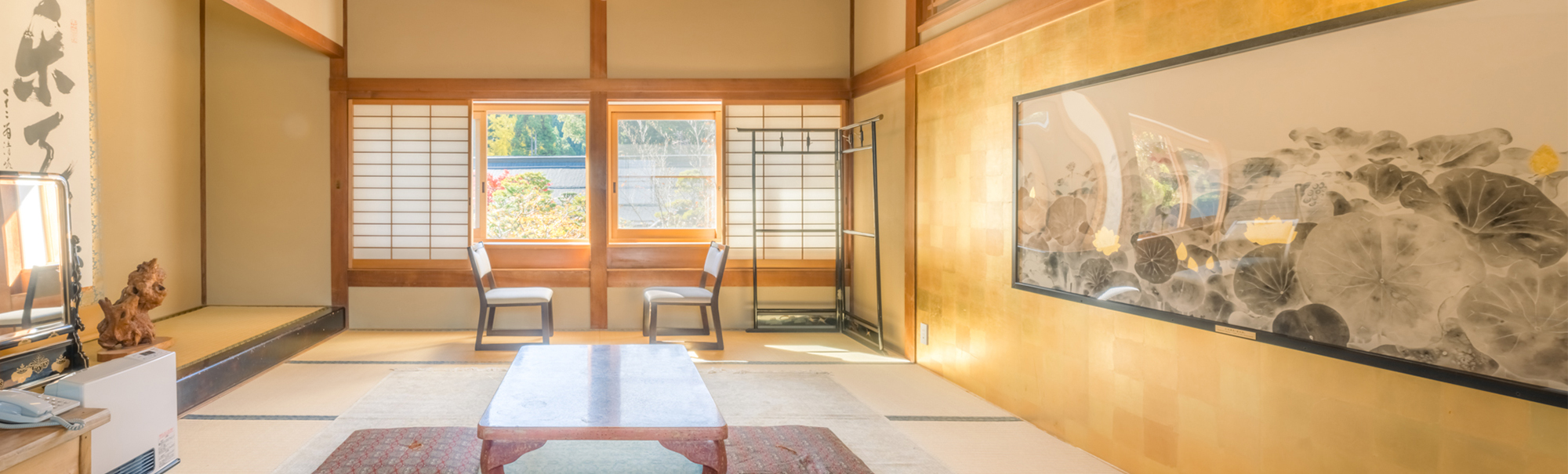
恵光院
A flagship Koyasan shukubo with English-guided Goma fire ceremony, Ajikan meditation, and nightly Okunoin tours.
from $130 /per night

福智院
The only Koyasan shukubo with a natural hot spring, three Mirei Shigemori gardens, and refined shojin ryori.
from $175 /per night
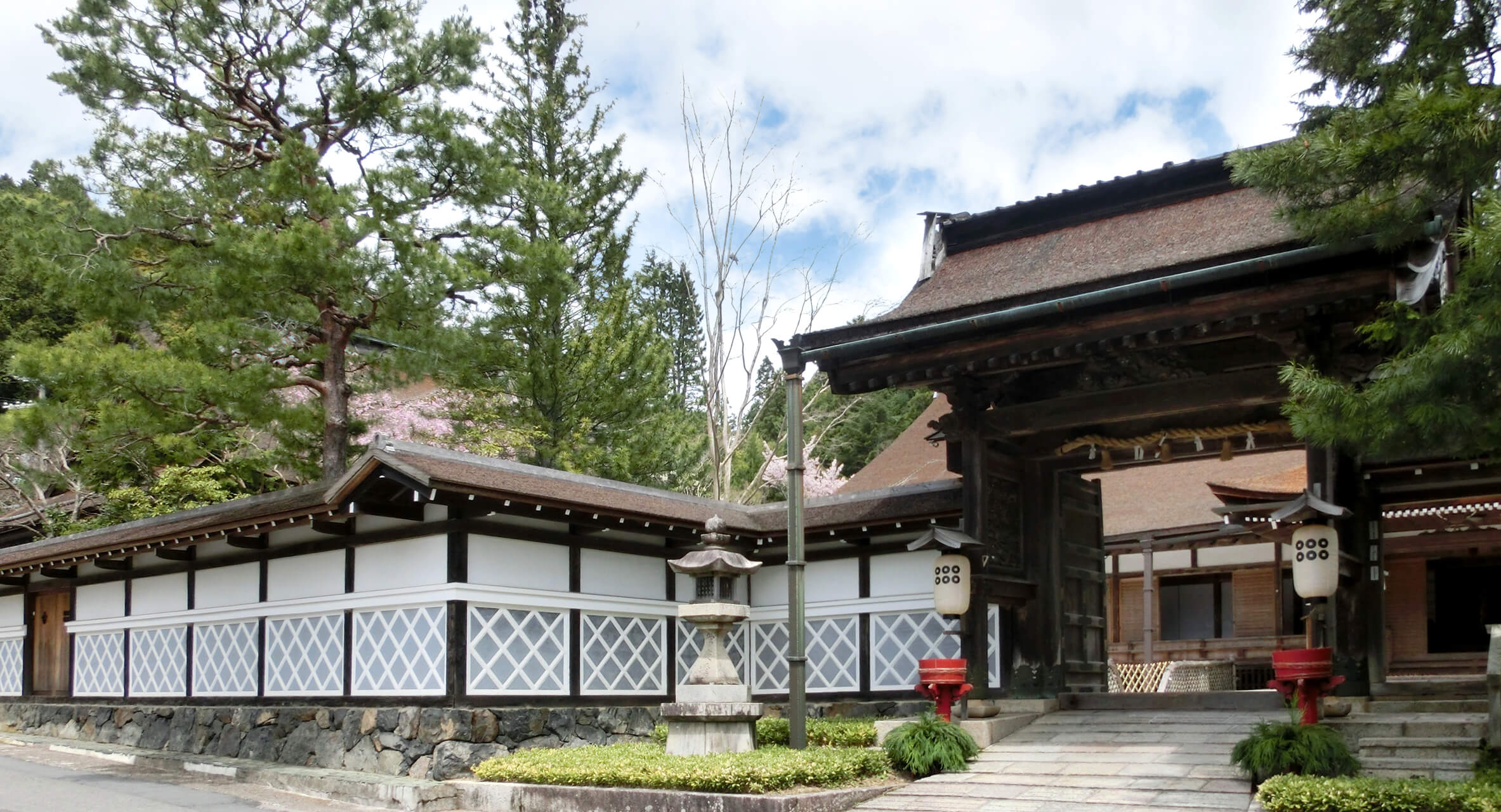
蓮華定院
A Sanada-family bodaiji shukubo on Mt. Koya with English-speaking monks, just 13 rooms, and a strong samurai-era heritage.
from $230 /per night
Explore Destinations

