|
|
|
|
|
|
There are fifteen rocks in the most famous garden in Japan, and from no single seat on the veranda can you see all fifteen at once. People walk onto the wooden deck at Ryoan-ji, raise a phone, take the photograph, and leave inside ninety seconds — and almost all of them miss the one fact the garden was built to teach. Fifteen rocks, set in five groups on a rectangle of raked white gravel about the size of a tennis court, framed by a low earthen wall stained by three centuries of rain. Wherever you sit, at least one rock hides behind another. The incompleteness is not an accident. It is the entire point, and it is the difference between looking at a Zen garden and using one.
This is a guide for the traveler who is drawn to those raked gravel landscapes and senses there is more going on than a pretty arrangement of stones — who wants to understand the *karesansui* not as a backdrop for a photograph but as the instrument it actually is. A Zen garden is a meditation tool the way a cushion is a meditation tool: it does nothing on its own, and almost everything if you sit with it correctly. What follows is what the dry landscape garden is, where it came from, how to read one, how to use the act of looking as a practice, and which temples let you wake up beside a great garden rather than queue to glimpse one.
The word karesansui (枯山水) breaks into three characters that tell you almost everything: *kare*, dry or withered; *san*, mountain; *sui*, water. A dry-mountain-water garden — a landscape of mountains and water made without any water at all. The white gravel, usually crushed granite, stands in for the sea, a river, or an expanse of cloud. Rocks set into the gravel become islands, mountains, waterfalls, or animals crossing a stream. Raked lines in the gravel become ripples, currents, or the still concentric rings around a stone. Moss, when present, suggests forest or shoreline. There are no flowers to bloom and fade, no pond to freeze, often no plant life at all. The garden is built to hold still while you change in front of it.
The dry landscape garden is a uniquely Zen invention, and it arrived at a specific moment. Japanese gardens before the medieval period were strolling gardens and pond gardens, built for aristocrats to wander through, boat across, and compose poems beside. The *karesansui* turned that inside out. It was not made to be entered. It was made to be looked at from a fixed point — usually a temple veranda — by a person sitting still. That shift, from a garden you move through to a garden you sit before, is the shift from entertainment to contemplation, and it happened during the Muromachi period (roughly 1336 to 1573), the same centuries in which Zen Buddhism reshaped the aesthetics of the entire country.
Zen, and the Rinzai school in particular, became the culture of the ruling samurai class during the Muromachi era, and with it came a whole vocabulary of restraint: ink-wash painting in monochrome, the tea ceremony stripped to its essentials, Noh theater slowed almost to stillness, and the rock garden emptied of everything but stone and gravel. The dry landscape was the garden form of a religion that taught that ultimate reality could not be grasped through addition — through more color, more incense, more scripture — but only through subtraction, through stripping away until what remained was bare enough to point past itself. A *karesansui* is subtraction made visible. It is what is left when a garden is reduced to its irreducible bones.
It helps to know who actually built them. The great dry gardens were not designed by monks alone but often by *kawaramono* — outcaste laborers, skilled stone-setters of the riverbank who knew exactly how a rock wants to sit in the earth — working under the eye of a Zen abbot or a tea master with a strong aesthetic opinion. Soami, Kobori Enshu, and a handful of named designers are credited with specific gardens, but most of the masterpieces are anonymous, collaborations between a religious sensibility and a craftsman’s hand. The result reads as effortless. It is not. A garden like Ryoan-ji’s is as carefully composed as a piece of music, and every apparent accident — the lean of a stone, the gap between two groups — was placed.
Knowing the history changes how you stand in front of one. A dry garden is not a decorative leftover from a vanished court culture; it is the surviving expression of a specific spiritual claim about how reality is approached. The samurai who knelt on these verandas were not relaxing — they were practicing, using the garden the way they used the tea bowl and the meditation cushion, as a discipline of attention. To sit before a *karesansui* today and treat it as scenery is to use a precision instrument as a paperweight. Once you see it as the tool the Muromachi monks built, the next question answers itself: how do you actually use it?
A Zen garden can be read, but not the way a sign or a story is read. There is no caption, no narrative, no single correct interpretation the garden is hiding from you. Reading a *karesansui* means slowing down enough to notice the design decisions, then letting those decisions work on your attention. Four ideas unlock most of what you will see: the fifteenth rock, asymmetry, *ma*, and borrowed scenery. Once you can see these, you stop looking at a garden and start looking with it.
Start with the fifteenth rock, because Ryoan-ji built its whole reputation on it. Fifteen stones, five groups, and a viewer who can never see more than fourteen from any position on the veranda. Fifteen, in Buddhist numerology, is the number of completeness — the full moon falls on the fifteenth night. To always be denied the fifteenth is to be shown, physically and inescapably, that completeness cannot be possessed from where you stand. Move along the deck and a hidden rock appears, but another vanishes behind it. There is no winning seat. The garden is a small machine for demonstrating that the whole is never available all at once to a single fixed viewpoint — which is, more or less, a foundational teaching of Zen rendered in granite.
Next, asymmetry. Western formal gardens — Versailles, the Italian Renaissance — are built on the axis and the mirror: matched halves, central paths, symmetry as an expression of order imposed on nature. The *karesansui* refuses all of it. The rock groups at Ryoan-ji are five, an odd number; they are sized 5-2-3-2-3 from one end, deliberately uneven; no two groups echo each other; nothing sits dead center. This is the principle the Japanese call *fukinsei*, asymmetry, one of the formal qualities of Zen aesthetics. The eye, denied a center to rest on, keeps moving, keeps weighing one group against another, never settles into the passive comfort of a balanced picture. An asymmetric composition is restless in exactly the way that keeps you awake. The garden will not let you stop looking.
Then *ma* — the most important and least visible element, because it is the emptiness. *Ma* is the Japanese concept of meaningful interval: the space between things, the pause that gives the notes their shape, the silence that makes the sound. In a rock garden, *ma* is the raked gravel — the wide, empty, deliberately featureless field between the rock groups. A Westerner reads that emptiness as background, as the canvas the rocks are painted on. The Zen reading inverts it: the gravel is not the absence around the rocks, it is the active presence that the rocks merely punctuate. Learn to look at the gravel itself — its raked lines, its tininess, its sheer extent — and the garden flips inside out. The emptiness becomes the subject. This single perceptual shift is the closest a garden can come to teaching a meditation insight directly.
Finally, *shakkei*, or borrowed scenery — the technique of composing a garden so that distant features beyond its walls become part of it. A mountain on the horizon, the curved roof of a hall, a stand of cedars across the valley: the garden frames them with a clipped hedge or a low wall and pulls them into the composition, so that the bounded foreground and the unbounded distance read as one continuous landscape. *Shakkei* dissolves the boundary between the garden and the world, which is precisely the boundary Zen practice is trying to dissolve in the mind. Not every dry garden uses it — Ryoan-ji’s famous wall actually shuts the world out — but where you find it, notice how your sense of the garden’s size quietly stops corresponding to the size of the temple’s actual plot.
These four are not a checklist to run through and tick off. They are doors. The fifteenth rock teaches that no viewpoint is complete; asymmetry keeps the eye from settling; *ma* turns the emptiness into the subject; *shakkei* erases the boundary. Each one, noticed properly, slows you down and pushes your attention somewhere it would not otherwise have gone — which is the whole function of the garden. You do not need all four at every garden, and you do not need to name them while you sit. You only need one of them to genuinely catch your attention, and the garden has done its work.
Tip
When you reach a garden, resist the phone for the first three minutes. Sit, find the lowest comfortable spot on the veranda, and simply count the rock groups, then trace one raked line of gravel all the way from one end to the other with your eyes. The photograph will still be there afterward, and it will be a better photograph, because by then you will actually be seeing the garden instead of composing it.
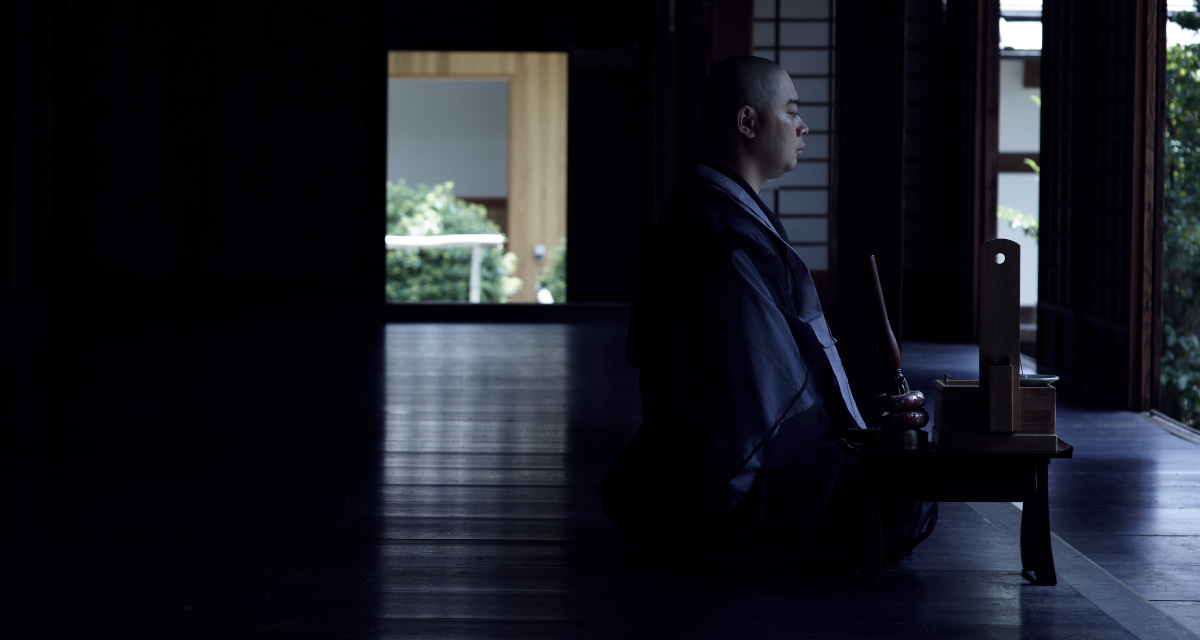
Here is the part the guidebooks skip. A *karesansui* is not primarily a thing to see; it is a thing to sit in front of, and the sitting is a recognized contemplative practice with its own logic. The Japanese veranda — the *engawa*, the wooden deck that runs along the edge of a temple hall, half-inside and half-outside, roofed but open to the air — is not an architectural afterthought. It is the meditation seat the whole garden is built to be viewed from. You take off your shoes, you sit on the warm or cool boards, you settle, and the garden does the rest. Many great dry gardens cannot be entered at all. The veranda is the only correct relationship to them, and that relationship is contemplative by design.
What you actually do is a form of slow looking that has more in common with the breath-watching of *zazen* than with sightseeing. You let your gaze go soft and wide rather than darting from feature to feature hunting for the “best” view. You stop trying to decode the garden — to decide what the rocks represent, whether that group is a tiger crossing a river or islands in a sea — and you simply let the composition rest in your visual field while your attention settles. The mind, given a stable, low-information, perfectly still object, slows to match it. This is not metaphor. A garden with nothing happening in it gives the restless mind nothing to chase, and after a few minutes the chasing quiets on its own. The garden meditates you, in a sense, by withholding stimulation.
Bring the breath into it and the practice deepens. Sit on the veranda, lengthen your spine the way you would on a cushion, and let your eyes rest on the gravel — not on a rock, on the empty raked field, the *ma*. Breathe slowly through the nose. On each long exhale, let the gaze soften a little more, until the rocks stop reading as separate objects and the whole rectangle becomes a single still image. Thoughts will arrive — your itinerary, your knees, the tour group behind you — and you treat them exactly as you would in seated meditation: notice, release, return to the gravel and the breath. Ten minutes of this in front of a great dry garden is a genuine sit, and the garden is doing half the work of holding your attention that the bare wall does in a meditation hall.
The light matters more than you would expect. A dry garden is the same arrangement of stones at every hour, but the raking shadows of early morning, the flat glare of noon, the long gold of late afternoon, and the slow blue of dusk make four entirely different gardens out of one. White gravel is a screen for light. This is the single strongest argument for staying at a temple with a garden rather than visiting one: a day guest sees the garden in the harsh, crowded middle of the day, while an overnight guest can sit on the veranda at dawn when the dew is still on the moss and the gravel is the color of pale ash, with nobody else on the deck. That early sit, alone, is when garden viewing stops being an idea and becomes an experience.
The famous gardens are day-trip gardens — you queue, you look, you leave. The deeper experience is to sleep beside a garden in a *shukubo* and sit with it at the hours the crowds never see. A handful of temple lodgings put you within steps of a serious dry landscape, and these are the ones worth building an itinerary around.
On Koyasan, Fukuchi-in is the rare *shukubo* where you can stay overnight and wake beside not one but three twentieth-century masterpieces. The temple’s gardens were designed in the Showa period by Mirei Shigemori, the modernist landscape architect who, more than anyone, dragged the *karesansui* tradition into the twentieth century without breaking it. Shigemori’s stone arrangements are sharper and more dynamic than the serene classics of Kyoto — bold diagonal thrusts of rock, gravel raked into restless modern patterns — and to see them at Fukuchi-in is to understand that the dry garden is a living art form, not a museum piece. Fukuchi-in is also the only lodging on the mountain with its own natural hot spring, so you can soak after an evening sit on the veranda. Of every temple in this guide, it offers the strongest pure garden-and-stay combination, and it sits inside the larger Koyasan monastic experience.
In Kyoto, Shunkoin is the thinking traveler’s garden stay. A subtemple of the vast Myoshin-ji complex in the city’s west, Shunkoin runs the most English-articulate program of any temple in this guide — its vice-abbot has spent years explaining Zen aesthetics to international guests in plain, unmystified language. The grounds hold a quiet dry garden, and the appeal here is that someone will actually tell you how to read it, connecting the rocks and gravel to the meditation practice the temple also teaches. Guests can stay overnight in the temple’s lodging and pair garden contemplation with morning *zazen*, which is the most coherent single combination of seated and visual meditation you can arrange in one place. For the analytical visitor who wants the garden explained rather than merely admired, Shunkoin is the address.
Also within the Myoshin-ji walls, Hanazono Kaikan is the lodging attached to the head temple of the largest Rinzai school, and Myoshin-ji is a working landscape of dry gardens — the complex contains dozens of subtemples, many with their own raked-gravel courts, several of which open to the public on a rotating basis. Staying at Hanazono Kaikan puts you inside the gates of one of Japan’s greatest concentrations of Zen gardens, free to walk the gravel lanes between subtemples in the early morning before the day’s visitors arrive. The atmosphere is more formal and more Japanese than Shunkoin, the rooms plainer, but the location is unbeatable for a guest whose main interest is gardens: you are sleeping in the middle of the largest Rinzai monastic compound in the country, and Rinzai is the school that made the *karesansui*.
For a quieter, deeper register, Hokyo-ji sits in the mountains of Fukui, one of the original training temples founded in the Dogen tradition of Soto Zen. This is not a garden destination in the tourist sense — there is no famous masterpiece to queue for — and that is exactly its value. The grounds here are contemplative spaces attached to a real working training temple, and the experience is of stillness and remoteness rather than of a celebrated composition. A guest who has already seen the great Kyoto gardens and wants to understand the silence they were built to frame will find it here, far from any crowd, in a temple where the garden is simply part of the daily fabric of practice rather than a destination in itself.
Tip
If you can stay only one night for the gardens, make it Fukuchi-in on Koyasan. You get three Mirei Shigemori dry gardens you can sit beside at dawn, a natural hot-spring bath to soak in afterward, morning service, and the broader Koyasan monastic atmosphere — the densest single-night garden-and-practice combination in this guide.
A note on planning the stay itself: a garden-focused trip is really a meditation trip, and it pays to treat it like one. Pair a Koyasan night at Fukuchi-in with a Kyoto night at Shunkoin or Hanazono Kaikan, and you will have seen the modernist and the classical dry garden, slept beside both, and sat *zazen* in at least one of them. For the mechanics of booking, what to pack, and how a temple night actually unfolds, our [first-time shukubo guide](/blog/shukubo-first-time-guide) covers the practical ground, and the broader [Kyoto temple stay guide](/blog/kyoto-temple-stay-guide) maps the city’s lodging options around exactly these gardens.
Some of the greatest dry gardens belong to temples that do not take overnight guests, and you visit them by day. The trick is to arrive at the moment the crowds are thinnest — the opening hour or the last hour before closing — and to treat the visit as a sit rather than a stop. Two destinations are essential.
Ryoan-ji is the one everyone comes for, and it deserves the reputation. Built in the late fifteenth century at a Rinzai temple in northwest Kyoto, its dry garden is the most refined and the most enigmatic in Japan: fifteen rocks, five groups, a sea of raked white gravel, a low oil-earth wall, and nothing else — no plants, no water, no sculpture, no explanation. Scholars have argued for centuries about what it represents; tiger cubs crossing a river is the old folk reading, islands in an ocean is another, and the temple itself officially declines to say. The refusal is the point. Go at the eight o’clock opening, sit at the far left of the veranda, count the rocks, and find the fifteenth missing. Then stop counting and simply sit. Twenty minutes here at dawn is one of the great quiet experiences in the country.
The subtemples of Daitoku-ji are the connoisseur’s alternative, and arguably the richer destination. Daitoku-ji is a large Rinzai complex in northern Kyoto made up of more than twenty subtemples, several of which guard dry gardens as fine as any in Japan, with the advantage that they draw a fraction of Ryoan-ji’s crowds. Daisen-in, in the complex, holds a famous early-sixteenth-century *karesansui* that reads almost as a narrative scroll in stone — gravel flowing like a river from a mountain source, past a stone “boat,” out into a wide “ocean” of raked emptiness — a garden built to be read as a journey from turbulence to stillness, which is to say as a Buddhist life. Other subtemples open and close to the public on rotating schedules, so part of the pleasure is wandering the gravel lanes and discovering which gates are open. For a visitor who wants depth over fame, Daitoku-ji rewards a slow half-day.
You do not need a teacher, a cushion, or any belief to practice garden meditation; you need a dry garden, a place to sit on the veranda, and about fifteen quiet minutes. The practice is simple enough to describe in a paragraph and deep enough to repay years, which is true of most genuinely contemplative things. Here is a sequence you can use at any *karesansui* in Japan.
First, arrive early and choose your seat deliberately. The crowds are the enemy of the practice, so come at opening or in the last hour, and find the lowest, most stable spot on the veranda where you can sit without leaning. Take off your shoes if the deck requires it, sit cross-legged or on your heels or simply with your feet hanging, and let your spine lengthen. Spend the first minute just arriving — feeling the boards under you, the air, the temperature — before you do anything with the garden at all. You are setting up a sit, not framing a photo.
Second, look at the whole, then look at the empty. Take in the entire garden once, slowly, left to right, letting your eyes register the rock groups and the raked field without naming or judging anything. Then deliberately move your attention off the rocks and onto the gravel — the *ma*, the empty interval. Rest your gaze on the open raked space and keep it there. This is the move that turns sightseeing into meditation: you are choosing to attend to the emptiness rather than the objects, and the mind, given so little to grip, begins to quiet. Pair it with the breath — long, slow, through the nose — and on each exhale let the focus on the gravel soften and widen.
Third, when the mind wanders, return; and when you finish, do not rush. Thoughts will come, as they do on the cushion. You do not fight them or follow them — you notice you have drifted, and you bring the eyes gently back to the gravel and the breath back to the exhale. There is no goal state to reach, no insight you are required to have. The returning is the practice. After ten or fifteen minutes, let the sit end on its own rather than checking a clock; take one more slow breath, take in the whole garden a final time, and stand slowly. If you are staying overnight, repeat the sit at dawn and again at dusk and notice how the same stones become three different gardens. That comparison — the same arrangement, transformed by light and by your own changing attention — is the quiet lesson the *karesansui* was built to deliver. For how this fits alongside seated practice, see our [zazen experience guide](/blog/zazen-experience-japan) and the [comparison of temple meditation types](/blog/shukubo-meditation-types-compared).
Tip
Garden meditation travels home with you. You cannot take Ryoan-ji’s wall, but you can take the move: pick any still, low-information surface — a blank wall, a window of sky, a single houseplant against bare paint — and practice resting your gaze on the empty space around the object rather than the object itself, breathing slowly. The garden taught a skill, not just a view, and the skill works anywhere.
Often deliberately nothing fixed — and that ambiguity is intentional. Some dry gardens do carry a traditional reading: a stone group may be meant as islands in a sea, a tiger leading her cubs across a river, mountains rising from cloud, or a turtle and crane symbolizing long life. Daisen-in at Daitoku-ji, for example, reads fairly clearly as a river journey from a mountain source to a wide ocean. But the most celebrated garden of all, Ryoan-ji, has no agreed meaning, and the temple itself declines to assign one. The point of the rocks is not to encode a message you decode and then move on; it is to give your attention a still, irreducible object to rest on. If a reading helps you look longer, use it. If it makes you stop looking once you have “solved” the garden, drop it. The looking matters more than the meaning.
Longer than you think, and longer than almost anyone does. The average visitor spends well under two minutes at even the greatest gardens — long enough for a photograph, not long enough for the mind to slow. As a practice, ten to fifteen minutes on the veranda is the sweet spot: the first few minutes are spent settling and shedding the urge to move on, and only after that does the contemplative effect begin. There is no upper limit; practitioners have sat half-mornings in front of a single garden. If you have only a few minutes because of crowds, even three minutes of genuine soft-gaze looking, with the breath slowed, is worth far more than fifteen minutes of restless photographing. Quality of attention, not duration, is the variable that matters.
A dry garden is, by design, the most season-resistant garden form in Japan — that is part of its philosophical point, a landscape that does not bloom and fade. This makes the off-seasons surprisingly rewarding. Winter is arguably the ideal time: a dusting of snow on raked white gravel and dark rock is one of the most beautiful sights in Japanese gardening, the crowds are thin, and the cold air sharpens the stillness. Early spring and late autumn are comfortable and quiet on weekdays, though Kyoto’s gardens fill heavily during the cherry blossom window in early April and the maple-leaf peak in mid-to-late November. If you are coming primarily for the dry gardens rather than for flowers or foliage, deliberately avoid those two peaks and consider winter, when a *karesansui* shows its austere best and you may have the veranda to yourself.
Yes, though the most famous gardens and the best overnight stays are usually not the same temples. Ryoan-ji and Daitoku-ji’s subtemples are day-visit destinations and do not generally take lodging guests. But several *shukubo* put you beside excellent gardens with the priceless advantage of dawn and dusk access: Fukuchi-in on Koyasan, with its three Mirei Shigemori gardens; Shunkoin and Hanazono Kaikan inside the garden-rich Myoshin-ji complex in Kyoto; and Hokyo-ji in the Fukui mountains for a quieter contemplative setting. Staying overnight is the single biggest upgrade to a garden experience, because it gives you the garden in the early-morning light with no crowds — which is when garden viewing actually becomes meditation. The temples in this guide are all bookable for an overnight stay.
Almost always yes for the gardens themselves, with a few sensible limits. Photographing the dry garden from the veranda is permitted at Ryoan-ji, Daitoku-ji’s subtemples, and essentially every temple in this guide, and you are free to take the picture. The common restrictions are on photographing temple interiors, altars, and Buddhist statues, where signs frequently prohibit it, and on the use of tripods, which are widely banned because they obstruct other visitors on a narrow veranda. The deeper etiquette, though, is not a rule but a courtesy: a Zen garden is a contemplative space, and a row of people sitting quietly in front of it should not be disturbed by someone moving around for the perfect angle. Take your photograph, then put the phone away and sit. The garden will reward the second act far more than the first.
The fifteen rocks of Ryoan-ji have not moved in five hundred years. The gravel is raked into the same patterns the monks raked when the Ashikaga shoguns ruled Kyoto. Nothing about the garden is designed to entertain you, surprise you, or reward a quick glance — which is exactly why a quick glance comes away with nothing. The *karesansui* is one of the few works of art that openly refuses to perform, and that refusal is its instruction. It will not meet a restless mind halfway. It simply holds still and waits, the way a meditation hall holds still and waits, until the person in front of it slows down enough to receive what was there all along.
So treat the next dry garden you reach as the tool it is. Sit on the veranda, soften your gaze, find the empty gravel, and breathe. Let the missing fifteenth rock remind you that you were never going to grasp the whole of anything from a single fixed seat, and that the trying is the point. Then book a night beside one — at Fukuchi-in among the Shigemori stones, or inside the gravel lanes of Myoshin-ji — and meet the same garden at dawn, alone, in the pale light, when it stops being a photograph and becomes a practice. That is the garden the day-trippers never see, and it is the only one worth crossing the world for.
Ready to book?
Browse our curated collection of authentic Buddhist temple stays across Japan. Filter by region, sect, and experience.
開始探索Explore Destinations