|
|
|
|
|
|
Two hours north of the Tokyo crowds, the road climbs into a wall of cedar. The trees are not incidental scenery — the avenue of Japanese cedars leading into Nikko was planted four centuries ago, tree by tree, by a retainer who could not afford to donate gold to the new shogunal mausoleum and gave saplings instead. Today those cedars are the tallest, oldest living entrance to any sacred site in Japan, and they set the tone for everything that follows: Nikko is a place where the natural world and the spiritual world were deliberately braided together, where lacquered shrines glow against deep green mountains, and where the boundary between Shinto and Buddhism was, for most of its history, no boundary at all.
Nikko is one of the most logical day trips or overnight escapes from Tokyo, and a great many visitors arrive specifically wanting a *shukubo* — a Buddhist temple lodging — to round out the experience. This guide does something most Nikko articles avoid: it tells you the honest truth about whether you can actually sleep inside a temple here, what the spiritual sites genuinely offer, and how to build a satisfying trip around the reality on the ground rather than a brochure fantasy.
Nikko's religious history is older than its fame. The mountain was first opened as a Buddhist training ground in 766 by the monk Shodo Shonin, who founded the temple that would grow into Rinno-ji. For more than eight centuries Nikko was a remote mountain center of Tendai Buddhism and Shugendo mountain asceticism, the kind of place ascetics climbed to disappear from the world. Then, in 1617, everything changed: Tokugawa Ieyasu — the warlord who unified Japan and founded the shogunate that would rule for 250 years — was enshrined here as a deity. His grandson Iemitsu rebuilt the complex on a scale designed to overwhelm, and Nikko became the spiritual anchor of the entire Tokugawa state.
The result, inscribed by UNESCO in 1999 as the "Shrines and Temples of Nikko," is a single World Heritage property that contains two shrines and one temple — 103 buildings in a landscape that is itself part of the listing. Toshogu, the lavishly carved mausoleum of Ieyasu, is the headline act. But the temple at the heart of Nikko's Buddhism is Rinno-ji, and the third element, Futarasan Shrine, predates both. Understanding how these three fit together is the key to Nikko.
Rinno-ji is the head temple of *Tendai* Buddhism in eastern Japan — the Nikkozan school of the broader Tendai tradition, whose national headquarters sit on Mount Hiei (Enryaku-ji) outside Kyoto. Tendai is one of the oldest and most influential schools of Japanese Buddhism, founded in the early ninth century by the monk Saicho after he brought the teachings of the Lotus Sutra back from China. It is sometimes called the mother of Japanese Buddhism because so many later schools grew from monks who trained on Mount Hiei first: the founders of Pure Land, Zen, and Nichiren Buddhism all began as Tendai monks before striking out on their own. Tendai is famously comprehensive — it holds that meditation, esoteric ritual, devotional chanting, and study of the Lotus Sutra are all valid paths up the same mountain — which is one reason it could absorb Nikko's older mountain-worship traditions so completely.
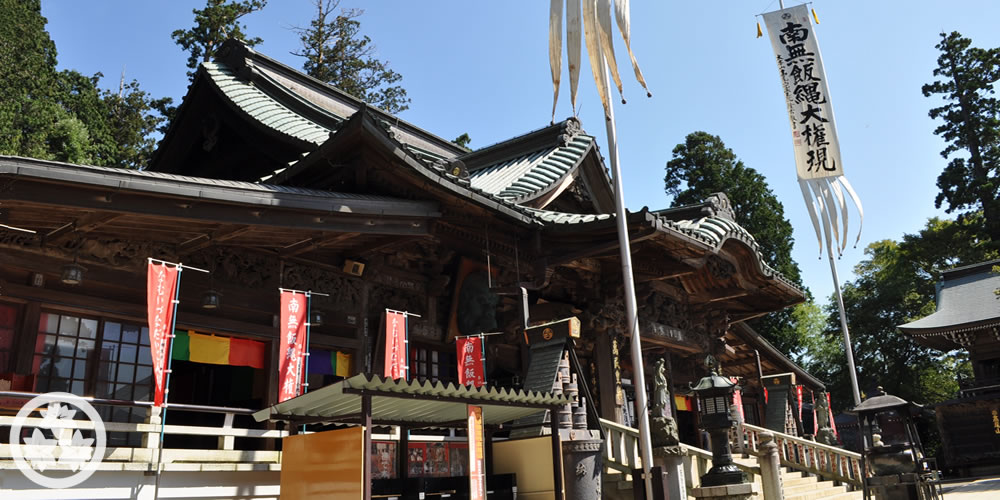
At Rinno-ji this lineage is alive in daily ritual. The temple performs goma fire ceremonies — an esoteric rite in which prayers written on wooden tablets are burned in a roaring sacred fire, the smoke carrying petitions skyward — in its great prayer hall, and offers sutra copying to anyone who wishes to sit and trace the Heart Sutra in ink. Its centerpiece, the Sanbutsu-do (Three Buddha Hall), is the largest wooden religious building in eastern Japan and enshrines three colossal gilded Buddha statues — Senju Kannon (the thousand-armed Kannon), Amida Nyorai, and Bato Kannon (the horse-headed Kannon) — each more than seven meters tall. These three are not arbitrary: they are the Buddhist manifestations of the deities of Nikko's three sacred mountains, the doctrinal hinge on which the whole shrine-and-temple fusion turns. Standing in front of them, dwarfed and gold-lit in the dim hall, is the single most powerful Buddhist moment available in Nikko.
For most of Nikko's history, Toshogu, Futarasan, and Rinno-ji were not three separate institutions but a single fused complex of shrine-and-temple worship — the syncretic system called shinbutsu-shugo, in which kami (Shinto deities) and buddhas were understood as different faces of the same sacred reality. They were administratively split only in 1868, when the new Meiji government forcibly separated Buddhism from Shinto across Japan. Knowing this helps the visitor make sense of why a Buddhist temple, a deified-warlord mausoleum, and an ancient mountain shrine all stand a few minutes' walk apart, sharing the same cedars.
Here is the part most travel content quietly skips. Despite Nikko's deep Buddhist heritage and its constant association with the word shukubo in guidebooks, there is currently no genuine, publicly bookable Buddhist temple lodging in Nikko. We checked this carefully against the temples' own official sources rather than aggregator listings, because the gap between what is advertised and what actually accepts overnight guests is wide.
Rinno-ji itself — the obvious candidate, and the temple the region's tourism material most often associates with the word shukubo — does not operate public overnight lodging. What it does offer, and offers daily, is meaningful and easy to join: a goma fire ritual performed in its great prayer hall (no reservation required, simply turn up and sit), and sutra copying available throughout the day on the second floor of the goma hall, where you trace the characters of the Heart Sutra over a faint printed guide. These are real, substantive ways to engage with Tendai practice as a visitor — far closer to the temple's living religion than a quick photo of the Sanbutsu-do — but they are day experiences. They end, and you return to your hotel; there is no monk-led morning service, no temple breakfast, no futon in a temple room.
The historic temple lodgings around Nikko have, one by one, wound down their overnight operations. Onsen-ji, a Rinno-ji branch temple up by the hot springs of Yumoto, once ran a famous one-group-per-day shukubo beside its sacred bath; that overnight program has now ended, and the temple offers only seasonal day bathing. Other temples in the wider Nikko area — such as a Jodo-sect temple in the Okuwa valley — offer day-only programs of sutra copying and seated meditation, again with no overnight stay. Several "temple lodging" listings that surface in online searches turn out, on inspection, to be commercial ryokan near Toshogu rather than working Buddhist shukubo. A glossary point worth keeping straight: a shukubo is a lodging operated by a temple as part of its religious life, not simply any inn that happens to sit near a shrine.
Tip
If a Nikko "temple stay" listing offers private onsen baths, room service, a la carte sake, and no morning Buddhist service, it is almost certainly a hot-spring ryokan trading on the temple-town atmosphere — a perfectly nice stay, but not a shukubo. A genuine shukubo will mention things like a morning prayer service, sutra copying, vegetarian temple cuisine, and a curfew.
None of this should put you off Nikko. It simply reframes the trip: Nikko is one of Japan's richest day-visit pilgrimage landscapes, and the best plan is to treat the temples and shrines as the daytime heart of your trip and to sleep either in Nikko's excellent hot-spring lodging or — if a temple bed specifically is what you came for — at a working shukubo elsewhere in the Kanto region. Both options are covered below.
Because Nikko sits roughly two hours from central Tokyo, it works equally well as a long day trip or a relaxed overnight, and the right choice depends on what you want from it.
The day trip is genuinely viable and very popular. Leave Asakusa on an early limited express, reach the shrine area by mid-morning, and you can comfortably see Toshogu, Rinno-ji, and the Shinkyo sacred bridge, eat lunch in town, and still catch an afternoon train back to Tokyo. This is the right call if your time in Japan is tight, if you are based in Tokyo and do not want to move hotels, or if you mainly want to photograph the shrines and tick the World Heritage box. The cost is that you will be moving through Nikko at the same pace as every other day-tripper, and the deeper, quieter Nikko — Lake Chuzenji, Kegon Falls, the Yumoto hot springs up the mountain — is hard to reach and return from in a single day.
The overnight unlocks that deeper Nikko. With one night you can do the shrine complex at a human pace, ride the dramatic Irohazaka switchback road up to Lake Chuzenji and Kegon Falls in the late afternoon when buses thin out, soak in a hot spring, and catch the shrines again in the soft early light before the tour buses arrive. For autumn foliage in particular — when the day-trip crowds and traffic become genuinely punishing — an overnight is close to essential. Since Nikko has no public shukubo, the overnight will most likely be in a hot-spring ryokan or hotel in Nikko, Chuzenji, or nearby Kinugawa Onsen.
There is also a hybrid plan that many travelers overlook: a Tokyo-based temple stay paired with a Nikko day trip. You can sleep in a genuine Kanto shukubo and still spend a full day in Nikko, getting both experiences without compromise. More on that in the Kanto-substitute section.
A short orientation to what you are actually looking at, in walking order from the Shinkyo sacred bridge upward.
Start here, because it is where Nikko's Buddhism began in 766. The centerpiece is the Sanbutsu-do, the largest wooden building in eastern Japan, housing the three giant gold-lacquered Buddhas described above. Rinno-ji is not a single building but a scattered constellation of halls and sub-temples spread across the mountain, the surviving institutional body of what was once the dominant power in Nikko. Its most important satellite is the Taiyuin — the mausoleum of the third shogun, Iemitsu, the man who rebuilt Toshogu and revered his grandfather Ieyasu so completely that he asked to be buried facing him in death. The Taiyuin is deliberately more restrained than Toshogu, sunk into deep cedar forest, its gates a darker, mossier register of green and gold; many visitors find it more moving precisely because it is quieter and less ornamented.
Two corners of Rinno-ji reward the traveler who slows down. The Shoyo-en stroll garden is a small Edo-period landscape garden built around a central pond, designed to reveal a sequence of composed views as you walk its circuit — one of the most peaceful spots in the whole complex and routinely skipped by visitors hurrying to Toshogu. And the temple's treasure hall holds rotating displays of Buddhist art, statuary, and shogunal artifacts that contextualize what you are seeing outside. If you want to engage rather than merely look, Rinno-ji is also where you attend the goma fire ritual or sit for sutra copying — the closest you can come, day-only, to the inner life of a Tendai temple in Nikko.
Toshogu is the deified mausoleum of Tokugawa Ieyasu and the most ornate religious complex in Japan — deliberately so. Where most Japanese sacred architecture is restrained and natural-toned, Toshogu is an explosion of color, gold leaf, and more than 5,000 individual carvings, built to broadcast the absolute power of the Tokugawa shogunate. The lavishness was a political statement: Iemitsu poured the equivalent of a fortune into rebuilding it in 1636, partly to honor his grandfather and partly to demonstrate, to every visiting feudal lord, exactly how much wealth the new regime commanded.
Its most famous details are surprisingly small. The three wise monkeys — "see no evil, hear no evil, speak no evil" — are carved into the sacred stable, part of an eight-panel sequence depicting the life cycle of a human being through monkeys. The "sleeping cat" (nemuri-neko), barely the size of a hand, guards the path to Ieyasu's inner tomb; the popular reading is that the cat sleeps peacefully because the realm is at peace. The showpiece is the Yomeimon Gate, sometimes nicknamed the "Twilight Gate" because visitors are said to lose track of time admiring its hundreds of carvings until dusk falls. One of its supporting pillars is famously installed upside-down on purpose — a deliberate imperfection, since the builders believed a flawlessly complete structure would invite decline. Note that Toshogu is, today, a Shinto shrine rather than a Buddhist temple — but in Nikko that distinction is younger than the buildings themselves, imposed in 1868, and the structures were conceived under the older fused worship in which the line did not exist.
The oldest of the three institutions, Futarasan enshrines the deities of Nikko's three sacred mountains and quietly predates the showy Tokugawa monuments by centuries. It is the most genuinely sacred-feeling and least crowded of the three core sites, with moss, cedars, and a sacred spring. Futarasan also has affiliated shrines higher up the mountain, at Lake Chuzenji and on the summit of Mount Nantai, tying the whole landscape into a single object of worship.
A short walk from the main shrine cluster, the Kanmangafuchi Abyss is a riverside gorge formed by an ancient lava flow from Mount Nantai, lined with a row of stone Jizo statues — the bodhisattva who protects travelers and the souls of children. There were originally around a hundred; a flood in the early twentieth century swept many away, and roughly seventy remain, their red bibs and caps weathered, moss creeping up their shoulders. They are nicknamed the "Bake Jizo" (ghost Jizo), or sometimes the "counting Jizo," because the local saying goes that you can never count the same number twice walking up and back. It is free, atmospheric, and blessedly quiet — a complete tonal counterpoint to the gold and crowds of Toshogu, and one of the most rewarding twenty-minute detours in Nikko. Go in the morning light, with the river running loud below and the moss still damp, and the row of weathered guardians along the water is unforgettable. Of all Nikko's sites, this is the one that feels least like a monument and most like a living devotional landscape.
Beyond the shrine cluster, the sacred landscape climbs. The Irohazaka switchback road — two one-way roads of nearly fifty hairpin bends, each labeled with a character of the old Japanese syllabary — winds up the mountain to Lake Chuzenji, a caldera lake at around 1,250 meters formed when an eruption of Mount Nantai dammed the valley. Mount Nantai itself is a sacred peak, historically climbed as an act of worship, and Chuzen-ji temple on the lakeshore (a branch temple of Rinno-ji) enshrines the Tachiki Kannon, a standing Kannon carved, by tradition, by Shodo Shonin from a living tree still rooted in the ground. Nearby, the Kegon Falls drop nearly 100 meters in a single thunderous column — one of Japan's three most famous waterfalls, and at its most spectacular framed by autumn color. This high country is the contemplative payoff of an overnight stay; it is hard to reach, see, and return from comfortably on a single day trip from Tokyo.
Tip
Combination tickets are sold for the shrine and temple sites, but read carefully — the famous "sleeping cat" passage to Ieyasu's inner tomb and some Rinno-ji halls carry separate small fees. Budget extra time for the climb to the tomb; it is a steep flight of more than 200 stone steps under towering cedars, and the descent is where most people's best photos of the trees come from. If your knees object to stairs, the Sanbutsu-do and Shoyo-en garden at Rinno-ji are gentler ground.
The simplest route from Tokyo is the Tobu Railway line from Asakusa Station, which runs limited express trains (the "Spacia" and "Spacia X" services) directly to Tobu-Nikko Station in roughly 1 hour 50 minutes to 2 hours. These are reserved-seat, comfortable, and the most popular choice; book ahead in autumn and on weekends because they sell out. Tobu also runs slower, cheaper local and rapid trains for budget travelers willing to spend extra time.
If you hold a Japan Rail Pass, there is a JR option — Tohoku Shinkansen to Utsunomiya, then the JR Nikko Line to JR Nikko Station — which is faster on paper but requires a change and lands you at a station next door to the Tobu one. For most international visitors not optimizing a rail pass, the direct Tobu limited express from Asakusa is the cleaner choice. Tobu also sells "Nikko Pass" tickets that bundle the round-trip train with unlimited local buses around the shrines, Lake Chuzenji, and Yumoto — worth it the moment you plan to ride the bus up the mountain.
From either Nikko station, the shrine and temple area is about a 30-minute walk uphill or a short local bus ride (buses leave from directly outside the stations and are frequent). The walk takes you up Nikko's main street, past souvenir shops and the town's well-known yuba (tofu skin) restaurants — yuba being Nikko's signature food, originally temple fare prized by the monks for its protein — and finally to the vermilion Shinkyo sacred bridge arching over the Daiya River. The bridge is the traditional entrance to the sacred precinct: legend says Shodo Shonin could not cross the rushing river until two giant serpents formed a bridge of their own backs. It makes a good first photograph and a natural orientation point, with the shrine path climbing into the cedars just beyond it.
A practical word on timing the day. The shrines and Rinno-ji generally open around 8:00 AM and stop admitting visitors in the late afternoon (earlier in winter), so an early start is the single biggest lever you have over the Nikko crowds. The first hour after opening, before the Tokyo day-trip trains arrive, is when Toshogu is quietest and the light through the cedars is best. Tour groups tend to concentrate from late morning through early afternoon. If you are on a day trip, prioritize Toshogu and Rinno-ji early, eat lunch around noon, and use the early afternoon for the quieter Futarasan Shrine and Kanmangafuchi gorge as the main complex fills up.
Because Nikko sits at the end of a Tokyo commuter-ish line and has no public temple lodging of its own, the smartest itineraries pair it with somewhere that does the sleeping. There are three good models.
The Tokyo-base model. Keep your hotel in Tokyo and treat Nikko as a single big day out from Asakusa. This is the lowest-friction option and the right one if you are short on days or traveling with luggage you do not want to move. You sacrifice the early-morning and late-afternoon quiet at the shrines, but you keep your Tokyo evenings.
The Kinugawa Onsen model. Kinugawa Onsen is a hot-spring resort town one stop further along the Tobu line, about 15–20 minutes beyond Nikko, set in a dramatic river gorge. It has the abundant ryokan capacity that Nikko's shrine town lacks, plus family attractions and riverside baths. The classic two-day plan is shrines and temples in Nikko on day one, an overnight soak at Kinugawa, and Lake Chuzenji or a leisurely return on day two. This is the best plan for travelers who want a hot-spring ryokan experience and do not specifically need a Buddhist temple bed.
The Kanto-shukubo model. If sleeping inside a working Buddhist temple is non-negotiable, the move is to do it elsewhere in the Kanto region and visit Nikko as a day trip. The standout option is Takaosan Yakuoin, the Shingon temple atop Mount Takao on Tokyo's western edge, which runs a genuine temple lodging with a 5:30 AM morning service, goma fire ritual, ajikan meditation, sutra copying, and vegetarian *shojin ryori* temple cuisine. It is a true mountain shukubo less than an hour from central Tokyo. You can spend a night absorbing temple practice at Takao and devote a separate full day to Nikko's shrines — getting an authentic temple stay and Nikko's World Heritage landscape without forcing one place to be something it is not. We cover Takao and other accessible options in our guide to the [best shukubo near Tokyo](/blog/best-shukubo-near-tokyo).
Tip
Note that Takaosan Yakuoin's lodging runs its programs primarily in Japanese, with limited English support. If language is a concern, book through an agent or temple-stay service, prepare with a phrasebook, and lean on the universal parts of the experience — the fire ritual, the meal, the quiet — which need no translation.
Nikko is a year-round destination, but its undisputed peak is autumn. Because Nikko climbs from around 600 meters at the shrines to over 1,200 meters at Lake Chuzenji, the foliage cascades down the mountain over several weeks, so the koyo season is unusually long. The high country around Lake Chuzenji and Kegon Falls typically turns first, in mid-October, while the shrine area and the lower town peak in early-to-mid November. This staggering means you can almost always find color somewhere in Nikko throughout late October and November.
The trade-off is crowds and traffic. Autumn weekends on the Irohazaka switchback road up to Lake Chuzenji can mean hours of gridlock, and the limited express trains from Asakusa sell out well in advance. This is precisely the season when an overnight (at Kinugawa or in Nikko itself) pays off most, letting you reach the high lakes early and avoid the worst of the day-tripper congestion. If you specifically want to combine a temple stay with peak foliage, our guide to [shukubo for autumn foliage](/blog/shukubo-autumn-foliage) covers timing and the best leaf-viewing temples region by region.
The other seasons each have a case. Spring brings cherry blossoms to the shrine grounds in late April, a few weeks behind Tokyo because of the altitude. Summer is cool, green, and a genuine highland escape from Tokyo's heat, with the waterfalls at full volume. Winter is cold and can be snowy, but Nikko under snow — the gold of Toshogu against white and dark cedar — is starkly beautiful and nearly empty, though some mountain bus routes and facilities run reduced schedules.
Is there a shukubo in Nikko where I can stay overnight? Not currently. Based on the temples' own official information, Nikko has no genuine, publicly bookable Buddhist temple lodging at this time. Rinno-ji offers daily day experiences — a goma fire ritual and sutra copying — but no overnight stay, and the historic temple lodgings in the area (such as Onsen-ji at Yumoto) have wound down their overnight programs. Many "temple stay" listings near Nikko are actually hot-spring ryokan, not working shukubo. For a real temple bed, plan a shukubo elsewhere in Kanto and visit Nikko by day.
Can I do Nikko as a day trip from Tokyo? Yes, easily. A direct Tobu limited express from Asakusa reaches Nikko in under two hours, and a long day is enough to see Toshogu, Rinno-ji, Futarasan, and the Kanmangafuchi gorge before heading back. The shrine cluster is compact and walkable. What a day trip cannot comfortably include is the high country — Lake Chuzenji, Kegon Falls, and Yumoto Onsen — which is why an overnight is better if those are on your list.
How good is the English support in Nikko? At the major shrines and temples, reasonably good — Rinno-ji and Toshogu have English signage, pamphlets, and ticketing, and Nikko is used to international visitors. For the day experiences at Rinno-ji, the goma ritual and sutra copying are largely non-verbal and easy to join. If you instead opt for a Kanto temple stay like Takaosan Yakuoin, expect the lodging itself to run mostly in Japanese, so prepare accordingly.
How bad are the autumn crowds? Genuinely heavy at peak, and worth planning around rather than ignoring. Late October through mid-November is the busiest season Nikko has, the limited express trains from Asakusa sell out days ahead, and the Irohazaka road up to Lake Chuzenji can sit in gridlock for two or three hours on a peak Saturday or Sunday — a frustrating way to spend foliage season inside a stationary bus. The payoff is real: one of Japan's longest and most spectacular foliage displays, cascading down the mountain over several weeks. To enjoy it rather than endure it, reserve trains as early as you can, travel midweek if your schedule allows, stay overnight near Nikko or at Kinugawa so you are not commuting from Tokyo, and reach the high lakes first thing in the morning before the day-trip traffic builds. Done right, autumn is unquestionably the best time to see Nikko; done carelessly, it is the most stressful.
Can I combine Nikko with an onsen stay? Absolutely, and it is the most natural pairing. Kinugawa Onsen, one stop past Nikko on the Tobu line, is a hot-spring resort town with plenty of ryokan and makes an ideal overnight base. Nikko itself and Lake Chuzenji also have hot-spring lodging, and Yumoto Onsen up the mountain is a smaller, more rustic alternative. The standard plan is shrines by day, hot spring by night.
Nikko rewards honesty about what it is. It is not, at this moment, a place to sleep inside a temple — and pretending otherwise leads to disappointing bookings at ryokan dressed up as shukubo. But it is one of the most concentrated and beautiful sacred landscapes in Japan, a place where a 1,250-year-old Tendai temple, the gold mausoleum of the man who unified the country, and an ancient mountain shrine all stand together under the tallest cedars in the land. Treat it as the daytime spiritual heart of a wider trip, sleep in a hot spring at Kinugawa or a true shukubo back in Kanto, and time it for autumn if you possibly can.
If this is your first temple-focused trip to Japan, our [first-time guide to staying at a temple](/blog/shukubo-first-time-guide) walks through what to expect, and our guide on [how to book a shukubo](/blog/how-to-book-shukubo) covers the practical steps for securing a real temple bed near Tokyo to pair with your Nikko day. Plan the where-you-sleep and the where-you-pray as two separate, deliberate decisions, and Nikko becomes one of the best two days you can have within reach of Tokyo. Arrive with that clear picture, give the cedars and the gold the unhurried morning they deserve, and let the high lakes and the row of mossy Jizo do the quiet work that the gilded gates cannot — and you will understand why pilgrims have been climbing into these mountains for nearly thirteen hundred years.
Ready to book?
Browse our curated collection of authentic Buddhist temple stays across Japan. Filter by region, sect, and experience.
开始探索Explore Destinations