|
|
|
|
|
|
Most travelers meet the Sea of Japan side of Honshu by accident. They come for Kanazawa's gold leaf and its samurai district, ride the Hokuriku Shinkansen for the views, and only later discover that this quiet, snow-shadowed coast is one of the spiritual backbones of the country. The region is called Hokuriku — literally "north land" — and it stretches across three prefectures: Ishikawa, Toyama, and Fukui. For anyone who wants more than a museum-and-garden city break, Hokuriku offers something rarer: the chance to spend a night inside a working Zen monastery that has run, almost unchanged, for nearly eight hundred years.
That monastery is Eiheiji, the head temple of Soto Zen, hidden in the cedar forests of Fukui. It is the single most important reason to plan a temple stay in Hokuriku, and the honest center of gravity for this entire guide. Around it, Kanazawa offers two of the most atmospheric temple districts in Japan — Teramachi and Higashi Chaya — though, as we will explain frankly below, the city itself has very few bookable temple lodgings. This is a guide to doing Hokuriku properly: anchoring on Eiheiji, day-tripping through Kanazawa's temples, and weaving the whole thing into a larger Japan trip.
A *shukubo* — temple lodging — is not the same thing everywhere in Japan. On Koyasan, more than fifty sub-temples have turned hospitality into an art, complete with English-led tours and Mirei Shigemori gardens. In Hokuriku, the experience runs in the opposite direction: fewer options, deeper authenticity, and a strong sense that you are a guest inside someone else's discipline rather than a customer in a spiritual hotel. For travelers who have already done the polished version and want the real thing, that is precisely the appeal.
Hokuriku also rewards travelers who like contrast. Within a single day you can move from the gold-leafed opulence of a Kanazawa teahouse to the bare cedar floors of a Fukui meditation hall. The coast carries a different weather and a different mood from the Pacific side — heavy winter snow, slate-grey seas, a quietness that the Zen tradition seems to have grown out of rather than retreated into. The food is extraordinary too: Fukui's Echizen crab, Toyama Bay's firefly squid and white shrimp, and the refined *shojin ryori* Buddhist vegetarian cuisine served at temple tables.
And crucially, Hokuriku is now easy to reach. Since the Hokuriku Shinkansen extension opened in March 2024, the bullet train runs all the way from Tokyo through Kanazawa to Tsuruga in Fukui, putting the whole region within a comfortable day's travel of the capital. The infrastructure finally matches the destination.
There is one more reason Hokuriku suits a temple stay, and it is harder to put on a map: the region invented some of the vocabulary of Japanese spiritual life. Dogen chose Fukui for Eiheiji precisely because it was nowhere — far from court, far from rivals, far from the temptation to compromise. Mount Hakusan, straddling the Ishikawa–Gifu border, has been one of Japan's three great sacred mountains for over a thousand years, and the ascetics who climbed it laid down pilgrimage routes that still thread the region. When you stand in Eiheiji's Dharma Hall before dawn, or walk Teramachi's lanes at dusk, you are moving through a landscape that Japanese Buddhism treated as a frontier of practice rather than a backwater. That history is the quiet undercurrent beneath everything in this guide.
Tip
If your priority is the temple stay itself rather than city sightseeing, treat Fukui — not Kanazawa — as your base. Eiheiji is roughly 30 minutes from Fukui Station by bus, and Fukui now sits on the Hokuriku Shinkansen line. Many travelers wrongly assume Kanazawa is the obvious hub; for Eiheiji, Fukui is closer and simpler.
Eiheiji was founded in 1244 by Dogen Zenji, the philosopher-monk who brought Soto Zen to Japan after years of training in Song-dynasty China. He chose this remote valley deliberately — far from the politics of Kyoto, deep among the cedars — so that the practice could be pursued without distraction. Nearly eight centuries later, it remains exactly that: not a museum, not a UNESCO site, but a functioning monastic university where several hundred *unsui* (literally "cloud and water" trainee monks) live and train at any given time, following a daily schedule barely changed since Dogen wrote it down.
The complex sprawls up a steep hillside as a chain of seven main halls connected by covered wooden walkways, all under a canopy of 700-year-old cedars. The seven halls — the Sanmon gate, the Buddha Hall, the Dharma Hall, the monks' hall, the kitchen, the bath, and the toilet — are arranged in the shape of a seated human figure, an old monastic convention that treats the entire monastery as a body at meditation. The covered corridors that link them are scrubbed daily by trainee monks as part of their practice; the wood gleams from centuries of bare feet and cloth. In winter the snow piles deep on the roofs and the whole place takes on the hush of a sealed world. Even as a day visitor — and tens of thousands come each year — you can feel the difference between this and a tourist temple: the monks you pass are not performing for you; they are simply going about their training.
Understanding Soto Zen even a little will deepen the visit. Where the more famous Rinzai school uses koan riddles to jolt the mind toward awakening, Dogen taught shikantaza — "just sitting" — the idea that seated meditation is not a means to enlightenment but the expression of it. Everything at Eiheiji follows from that: the silence, the precision of the meals, the insistence that sweeping a corridor or washing a bowl is itself the practice. This is why a stay here can feel austere to the point of severity. Nothing is decorative. Nothing is for the guest's benefit. You are being shown a way of living in which the boundary between the sacred and the everyday has simply been erased.
The deepest way to experience Eiheiji is the *sanro* program — literally a "secluded retreat" — which lodges lay guests inside the temple's training hall and walks them through a simplified version of the monastic day. Check-in is in the early afternoon. The program includes instruction in *zazen* seated meditation, an evening meal taken in formal style, a Dharma talk, and lights-out around 21:00. You are woken before 4:00 AM by a hand-bell — the same call the resident monks hear — for pre-dawn zazen and the morning service in the Dharma Hall, followed by a silent breakfast. The cost is remarkably low, because you are not a hotel guest; you are a temporary practitioner. The temple expects sincerity, silence, and a willingness to follow instructions you may not fully understand.
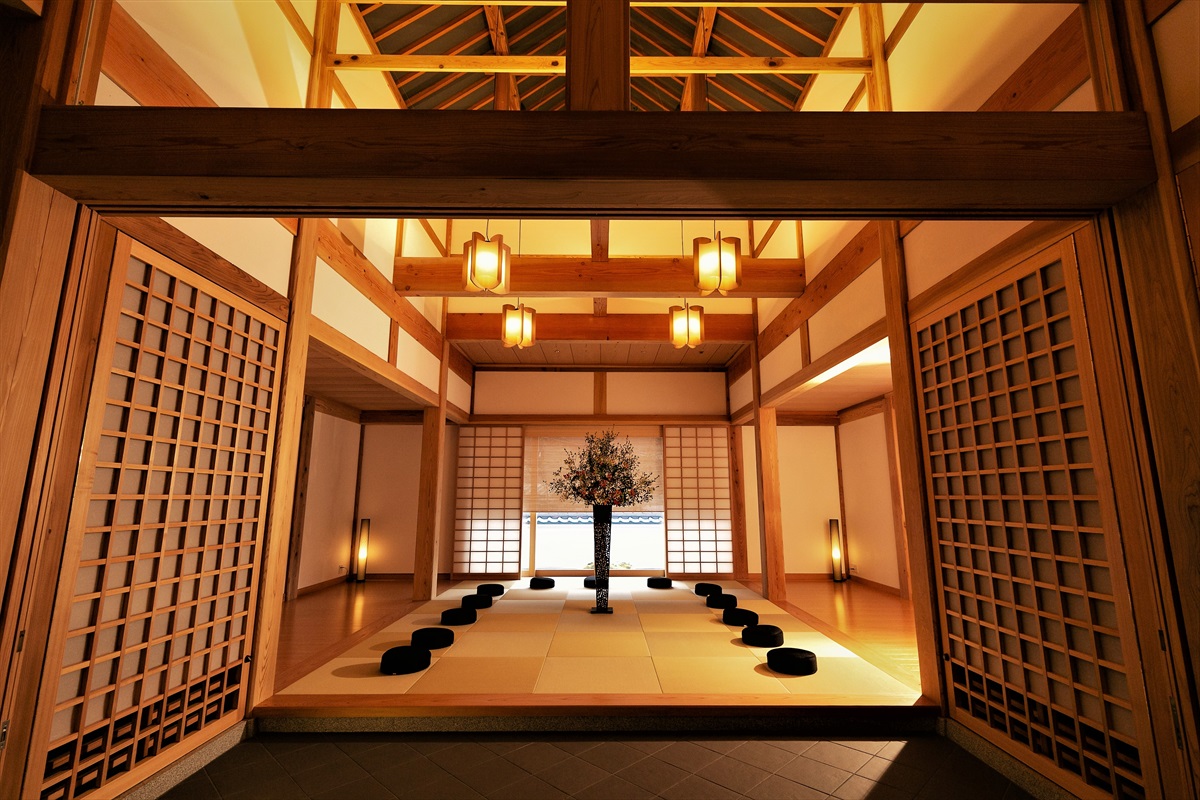
For travelers who want the Eiheiji atmosphere without the full rigor of sanro, there is an excellent middle path at the temple gate: Hakujukan, an 18-room inn that opened in 2019 as a partnership between a hospitality company, the local town, Fukui Prefecture, and the temple itself. The rooms are spacious and finished with cedar harvested from Eiheiji's own forest. Dinner is supervised by the temple's kitchen master and draws on shojin ryori principles while incorporating Echizen seasonal ingredients. The signature feature is the Zen Concierge program: staff certified by the temple lead an early-evening zazen session in the inn's meditation hall, and accompany willing guests to the pre-dawn morning service inside Eiheiji itself the next morning.
In effect, Hakujukan lets you sleep comfortably, eat extremely well, and still walk into the monastery at dawn for the genuine article. It is the rare lodging that splits the difference without diluting either side, and its English support is real — making it the most foreigner-friendly serious Zen stay on the Hokuriku coast. If you want a fuller comparison of Eiheiji against Japan's other great monastic mountain, see our guide on Koyasan vs Eiheiji.
Whichever option you choose, it helps to know what the morning actually feels like, because it is the heart of the experience. You wake in the dark to the sound of a bell, dress quickly in the cold, and file in near-silence through the cedar-scented corridors to the Hatto, the Dharma Hall. The monks chant the morning sutras in a low, rolling drone that fills the rafters; incense hangs in the lamplight; and you sit, mostly motionless, as the sky outside slowly greys toward dawn. There is no performance, no explanation, no concession to the fact that you do not understand the words. You are simply present at something that happened yesterday, will happen tomorrow, and has happened every single morning for the better part of eight centuries. Travelers who arrive sceptical often describe this moment as the one that stayed with them long after the trip ended.
Tip
Sanro reservations are taken at least one month in advance, and the program is sometimes adjusted or suspended for international applicants depending on the season and the monastery's training calendar. Always confirm directly before building your itinerary around it. If a sanro spot is not available for your dates, Hakujukan is the reliable fallback that still gets you into the morning service.
A practical word on the meals, because they surprise people. The shojin ryori served at Eiheiji and Hakujukan is fully vegetarian — no meat, no fish, no stock made from animals — and traditionally avoids the "five pungent" alliums such as garlic and onion, which are thought to agitate the mind. What arrives instead is a quiet, precise sequence of dishes built around sesame tofu, mountain vegetables, pickles, miso, and rice, plated with the same care a kaiseki chef would lavish on luxury ingredients. In the sanro program the meal is taken in formal silence, in a prescribed order, and you are expected to finish everything in your bowl — wasting food is treated as a small failure of attention. It is one of the most memorable parts of the stay, and a genuine education in how little a satisfying meal actually requires.
Eiheiji is also surrounded by a small constellation of other temples worth knowing about, several of them in the same valley and on the same bus routes. They make natural additions to a temple-focused day in Fukui and round out the picture of why this corner of Hokuriku, not Kanazawa, is the true heart of the region's spiritual life. Worth a mention too is the Eihei-ji town approach itself: a short street of soba shops, sesame-tofu makers, and pilgrim supply stores leading up to the gate, where you can eat the local oroshi-soba — buckwheat noodles topped with grated daikon — before or after your visit. It is a reminder that even the most austere monastery sits inside an ordinary, living community.
Here is the honest truth that many guidebooks bury: Kanazawa city itself has almost no bookable shukubo. The city is famous for Kenrokuen Garden, its gold leaf, the Higashi Chaya geisha district, and the Nagamachi samurai quarter — but if you arrive expecting to sleep in a temple within the city limits, you will mostly be disappointed. Kanazawa is a temple-rich city to walk through, not to sleep in. Understanding that distinction will save you a lot of frustrated searching.
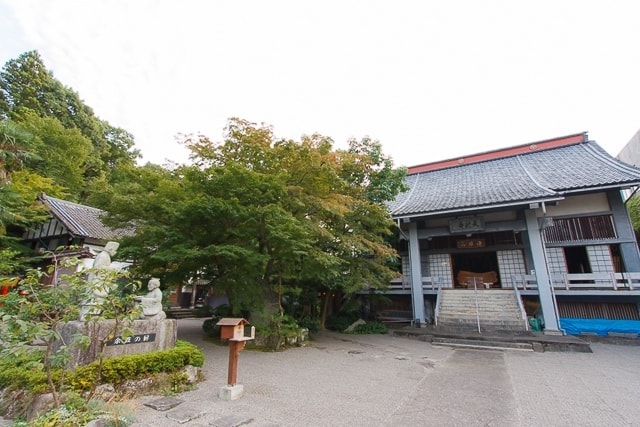
What Kanazawa does have, in abundance, are temple districts that are among the most atmospheric in Japan. The first is Teramachi — literally "temple town" — a quiet hillside neighborhood across the Sai River where roughly seventy temples were deliberately clustered in the early seventeenth century by the ruling Maeda clan. The placement was strategic as much as spiritual: the temples formed a defensive buffer guarding the southern approach to Kanazawa Castle. Today Teramachi is a maze of narrow lanes, mossy gates, and wooden temple walls, almost entirely free of tour buses. It is one of the best places in the city for an unhurried, contemplative half-day on foot.
The single most famous building here is Myoryuji, universally nicknamed the "Ninja Temple." Despite the name, it has nothing to do with ninja. It was built in 1643 as a disguised lookout and refuge, riddled with hidden staircases, concealed rooms, trick doors, and a well rumored to connect to the castle by secret tunnel. Visits are by reservation and guided only (in Japanese, with English leaflets), and it is genuinely one of the more surprising buildings in Japan — though it is a sightseeing stop, not a place to stay overnight.
On the opposite, eastern side of the city sits the Higashi Chaya district, Kanazawa's best-preserved teahouse quarter, where two-story wooden machiya glow under lattice windows at dusk. Strictly speaking this is a geisha-entertainment district rather than a temple one, but it sits at the foot of the temple-dotted Utatsuyama hillside, and the two areas flow together on foot. Walk up from the teahouses and you pass shrine torii and small temples almost immediately. The combined Higashi Chaya–Utatsuyama walk is one of the loveliest in Kanazawa, especially in the soft light of early morning before the crowds.
It is also worth knowing why Kanazawa is so dense with temples in the first place. Under the Maeda clan — the wealthiest feudal domain in Japan after the Tokugawa themselves — the city was planned with deliberate care, and religious buildings were concentrated into defensive clusters on the city's edges. Teramachi to the southwest and the Utatsuyama temple group to the northeast functioned as fortified gateways. The result, four centuries later, is that Kanazawa preserves whole neighborhoods of temples in their original layout, something the larger cities of Tokyo and Osaka largely lost to fire, earthquake, and war. Kanazawa survived the twentieth century almost untouched by bombing, which is why its temple districts feel so coherent and so old.
So how should you think about Kanazawa in a temple-stay trip? As the cultural and culinary base, and as a superb day of temple walking — but not as the place you sleep monastically. Spend your nights in a Kanazawa ryokan or hotel for the city portion of your trip, walk Teramachi and the Higashi Chaya–Utatsuyama temples by day, and reserve your actual shukubo night for Eiheiji, an hour or so down the line in Fukui. That division of labor is the key to planning Hokuriku well, and almost nobody states it plainly. The few accommodations in or near Kanazawa that advertise a "temple stay" experience are generally renovated temple buildings run as boutique inns rather than functioning religious lodgings — pleasant, but not the monastic experience that Eiheiji provides.
The third Hokuriku prefecture, Toyama, is often skipped by foreign travelers, which is part of its charm. It is best known for Toyama Bay — a deep glittering basin that produces firefly squid and white shrimp — and for the dramatic Tateyama mountains rising straight up behind the coast. The Tateyama Range has been a center of mountain worship for over a thousand years; in the medieval period Tateyama was considered one of Japan's three holiest peaks alongside Mount Fuji and Hakusan, and pilgrims climbed it as a literal journey through the Buddhist hells and paradises mapped onto the terrain.
For most travelers, the practical way to engage with this heritage is the spectacular Tateyama Kurobe Alpine Route, a chain of cable cars, ropeways, and trolley buses that crosses the mountains between Toyama and Nagano, famous for the towering "snow corridor" of springtime walls of plowed snow up to twenty meters high. It is one of the great mountain journeys in Japan. There is also a small but serious history museum at the foot of the range devoted to the old Tateyama faith, and the surviving pilgrimage village of Ashikuraji where mountain ascetics once gathered.
Toyama city itself is also home to one of the more striking modern temples in Japan, the riverside Buddhist complex designed in stark concrete and water at the foot of the Tateyama foothills, where the contemporary architecture frames the sacred mountains in the distance. It is a reminder that the Tateyama faith is not purely a museum piece; the mountains are still climbed by pilgrims and the worship is still alive. For a traveler with an interest in how Japanese religion sits in its landscape, a Toyama day adds real texture, even if it does not add a bed in a temple.
Be clear-eyed, though: Toyama is for landscape, mountain-faith history, and food, not for booking a temple lodging. There is no equivalent of Eiheiji's sanro program here for casual travelers. Slot Toyama in if you are crossing the Alpine Route or want a quieter coastal day, but do not expect it to deliver a temple stay. Its role in a Hokuriku itinerary is scenery and depth of context, not a night on a meditation cushion.
The most satisfying way to use Hokuriku is to treat Eiheiji as one half of a Zen-and-esoteric pairing with Koyasan, the great Shingon mountain in Wakayama. Eiheiji is austere, silent, and disciplined; Koyasan is ritual-rich, photogenic, and welcoming, with fire ceremonies and a vast lantern-lit cemetery. Experiencing both back-to-back is one of the most informative things a traveler can do in Buddhist Japan — the contrast teaches you more about the two traditions than any book.
Here is a clean two-temple framework over roughly a week. Days 1–2: Tokyo to Kanazawa on the Hokuriku Shinkansen; explore Kenrokuen, Higashi Chaya, and walk Teramachi's temples. Day 3: short train hop from Kanazawa to Fukui, then bus to Eiheiji; spend the night at Hakujukan or in the sanro program and join the pre-dawn service. Day 4: travel from Fukui toward Kansai — the Hokuriku line connects efficiently toward Kyoto and Osaka. Days 5–6: from Osaka, ride the Nankai railway and cable car up to Koyasan for a contrasting Shingon shukubo night, with the Okunoin cemetery walk and the morning fire ceremony. Day 7: down the mountain and onward to Kyoto or Kansai Airport.
The sequence matters more than people expect. Doing Eiheiji first and Koyasan second tends to land best emotionally: you begin with the stripped-down severity of Soto Zen, then arrive at Koyasan to find color, ritual, gardens, and the warm theatre of the Goma fire ceremony — a release after the discipline. Reverse the order and Eiheiji can feel like a sudden cold plunge after Koyasan's comforts. Neither is wrong, but if you have any choice in routing, ending on Koyasan gives most travelers the more satisfying arc. If a full week is too much, you can compress this to a four-day Kanazawa–Eiheiji loop and save Koyasan for a future Kansai trip; Eiheiji alone justifies the journey to the coast.
If you only have time for one mountain, choose based on temperament. First-timers, couples, and travelers who want gardens, English-led tours, and ritual spectacle should lean Koyasan; see our roundup of the best Koyasan temple stays to pick a sub-temple. Travelers who specifically want Soto Zen, can handle a 4:00 AM wake-up, and value depth over comfort should choose Eiheiji. If you have never sat zazen before, it is worth reading our guide to the zazen experience in Japan before you go, so the early-morning meditation is rewarding rather than bewildering.
The Hokuriku Shinkansen is the spine of any trip here. From Tokyo Station, the fastest Kagayaki services reach Kanazawa in around two and a half hours and continue to Fukui and Tsuruga following the 2024 extension. This single line makes a Tokyo-in, Kansai-out routing through Hokuriku genuinely practical, which it was not a few years ago.
For Eiheiji specifically, the gateway is Fukui Station. From there, the Eiheiji Liner direct bus runs to the temple in roughly 30 minutes, and there are also connections via the Echizen Railway plus a local bus. Coming from Kyoto or Osaka, the classic approach is the Thunderbird limited express to Fukui, then the same bus — though note that with the shinkansen extension to Tsuruga, Kansai connections now involve a transfer at Tsuruga. From Kanazawa, you backtrack slightly south: it is a short shinkansen or limited-express hop to Fukui, then the bus.
A few practicalities. The Hokuriku Arch Pass, valid on JR between Tokyo and Osaka via the Hokuriku route, can be excellent value if you are doing the full Tokyo-to-Kansai arc and is usable by foreign visitors. Within Kanazawa, the Kanazawa Loop Bus and a flat-fare city bus network connect the station, Kenrokuen, Higashi Chaya, and Teramachi cheaply. Toyama and the Tateyama Alpine Route require their own separate tickets and are best treated as a dedicated day rather than a casual add-on.
Tip
Buses to Eiheiji thin out in the late afternoon, and the monastery sits in a deep valley with no late-night transport. If you are doing the sanro program or staying at Hakujukan, plan to arrive by mid-afternoon and do not count on leaving the same evening. Build the temple night as a fixed, unhurried block in your schedule rather than squeezing it between other stops.
Hokuriku has four distinct and genuinely different seasons, and Eiheiji looks like a different temple in each. Late spring (May to June) is arguably the best all-round window: the cedars are vivid, the air is mild, the crab season has given way to other coastal delicacies, and the worst of the rainy weather has not yet arrived. Fresh greenery against the dark temple wood is one of the great sights of the region.
Autumn (late October to mid-November) is the photographer's season. The maples around Eiheiji and through Kanazawa's Kenrokuen and Teramachi turn fierce reds and golds, and the contrast with the moss and grey temple stone is unforgettable. It is also the most popular time, so book accommodation and any sanro spot well ahead.
Winter is the Hokuriku coast at its most atmospheric and most demanding. Heavy snow blankets Eiheiji's rooftops and the cedar forest, producing scenes of extraordinary stillness — but transport can be disrupted, and the cold inside an unheated meditation hall is real. It is also, not coincidentally, Echizen crab season in Fukui, when the prized snow crab is landed at ports along the coast and served at its peak. Summer is warm and humid with afternoon downpours; it is fine for the cities but less magical at the temples. If you can choose freely, aim for late spring or the autumn foliage.
One season-specific tip worth weighing: if your trip is in deep winter and you intend to do the sanro program, be honest with yourself about cold tolerance. The training halls are kept close to the outside temperature on purpose, and pre-dawn zazen in a Fukui January is a genuine test. Many winter visitors are happier choosing Hakujukan, where the room is warm and the morning service is something you opt into after a good night's sleep, rather than something you endure. There is no shame in the gentler door; the point is to experience the place, not to suffer for its own sake.
Can I stay in a shukubo in Kanazawa city? — Not really. This is the single most common misunderstanding about Hokuriku temple stays. Kanazawa has wonderful temple districts to walk through — Teramachi and the Utatsuyama temples near Higashi Chaya — but essentially no bookable temple lodgings within the city. For an actual shukubo night, you go to Eiheiji in neighboring Fukui. Use Kanazawa as your cultural base and sightseeing day, and reserve the temple stay for Eiheiji.
How do I get to Eiheiji from Kanazawa? — Take a short shinkansen or limited-express train south from Kanazawa to Fukui Station (roughly 30–45 minutes), then the Eiheiji Liner direct bus, which reaches the temple in about 30 minutes. The whole trip is comfortably doable in a morning. There is no need to base yourself in Kanazawa for Eiheiji — Fukui is closer — but the connection from Kanazawa is easy if that is where your trip begins.
Can I actually stay overnight at Eiheiji? — Yes. Lay guests can join the sanro program and sleep inside the temple's training hall, following a simplified monastic schedule with pre-dawn zazen and a silent breakfast. Spots are limited, must be reserved at least a month ahead, and are occasionally restricted for international visitors depending on the season. The comfortable alternative is Hakujukan, the inn at the temple gate, which still gets you into the early-morning service via its Zen Concierge program.
Is there English support? — At Hakujukan, yes — bilingual staff and English-language explanation of the zazen and morning service make it the most accessible serious Zen stay in Hokuriku. Inside the Eiheiji sanro program itself, English support is more limited and you should expect to follow along largely by observation, with printed guidance. Kanazawa as a city is well set up for foreign visitors, with English signage and tourist information. If this is your first temple stay anywhere, our first-time shukubo guide covers the etiquette and what to pack.
Can I combine Hokuriku with Kyoto? — Easily, and it is one of the most natural pairings in the country. Fukui connects efficiently toward Kyoto and Osaka by limited express (with a transfer at Tsuruga since the 2024 shinkansen extension), so a Kanazawa–Eiheiji leg flows straight into a Kyoto stay. Many travelers run the whole route as Tokyo → Kanazawa → Eiheiji → Kyoto → Osaka, often adding Koyasan from Osaka for a second, contrasting temple night.
How far ahead should I book, and what should I pack? — For the Eiheiji sanro program, treat one month as the minimum lead time and longer in autumn; spots are limited and confirmation is not instant. Hakujukan, being a hotel, can often be booked closer in but fills on weekends and in foliage season. For either, pack modest clothing that covers shoulders and knees, warm layers regardless of season (the halls are cold even in spring), thick socks for tatami floors, and a small flashlight or phone light for the unlit pre-dawn corridors. Leave heavy fragrance and noisy devices behind — silence is part of the experience, not an inconvenience to work around. Beyond that, the lighter your bag and your expectations, the better the night tends to go.
Hokuriku will never be the busiest temple-stay region in Japan, and that is exactly why it rewards the travelers who make the effort. Kanazawa gives you the gold leaf, the gardens, and a temple town to wander; Toyama gives you the mountains and the old faith of the high peaks; and Fukui gives you Eiheiji — a monastery that has been doing the same thing, at the same hour, in the same valley, for nearly eight hundred years. Build your trip honestly around that anchor: a base in Kanazawa, a day among its temples, and one carefully planned night at Eiheiji where the bell wakes you in the dark and, for a few hours, you are not a tourist at all. The Hokuriku Shinkansen has made the coast easy to reach, but the experience waiting at the end of the line has not changed and was never designed to. That gap — between the ease of getting there and the depth of what you find — is precisely what makes a Hokuriku temple stay feel like a discovery rather than a stop on a list.
Ready to book?
Browse our curated collection of authentic Buddhist temple stays across Japan. Filter by region, sect, and experience.
宿坊を探すExplore Destinations